Municipal Heritage Site
Portage la Prairie Canadian Pacific Railway Station
Portage la Prairie, Manitoba
Also known as Portage la Prairie Canadian Pacific Railway Heritage Centre and Park
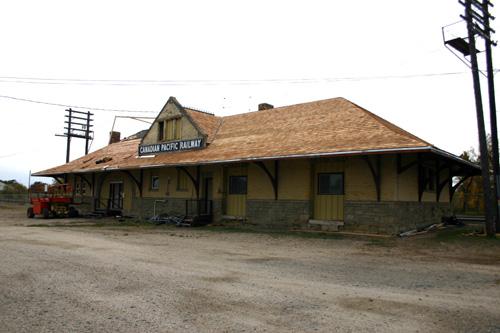
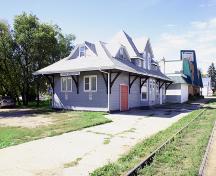
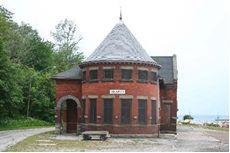
Primary Elevation, from the southeast, of the Portage la Prairie Canadian Pacific Railway Station, Portage la Prairie, 2005
Photo: Historic Resources Branch, Manitoba Culture, Heritage and Tourism, 2005
- Built
- 1893
- Recognized
- 2004
- By
- Local government
The register’s text, word for word
Description
The Portage la Prairie Canadian Pacific Railway (CPR) Station, built in 1893, is a 1 1/2-storey brick structure with a prominent roof and oversized base of sandstone veneer. The site's municipal designation applies to the building and the grounds it occupies on the northern edge of Portage la Prairie.
Heritage value
The Portage la Prairie CPR Station is a striking example of railway architecture in Manitoba, one noted for its imposing roofline, subdued Romanesque Revival styling and rare use of sandstone as a construction material. Unlike many other stations in the province, which are standardized wood-clad buildings, the Portage facility displays a specialized design by Edward Colonna of Montreal, one of several accomplished architects engaged by the CPR in the period before the company began relying almost exclusively on in-house designers. The station's Romanesque Revival characteristics, including a heavy rusticated base, massive round arches and textured, polychromatic surfaces executed in sandstone and brick, are intended to convey a corporate image of solidity and dignity and to signal Portage's regional importance as a railway and agricultural centre.
SourceCity of Portage la Prairie By-law No. 04-8220, April 12, 2004
Character‑defining elements
Key elements that define the site character of the Portage la Prairie CPR Station include:
- the expansive station grounds on 3rd Street NE
- the building's east-west orientation, immediately parallel to railway tracks to the north
Key elements of the station's Romanesque Revival styling include:
- the basic rectangular 1 1/2-storey mass enveloped by walls of clay brick wythes atop a high rusticated sandstone base
- the commanding low-pitched hip roof featuring wood shingles and slightly bellcast, deep overhanging eaves supported by large wooden brackets spanning from the eaves down to the top of the sandstone base
- the roof interrupted on the north and south slopes by single large gable dormers, each featuring brick ends with a bank of three windows separated by rounded brick elements and encased in continuous stone lintels and sills
- the rectangular openings throughout, save the windowless west end, with most windows featuring heavy rusticated stone lintels and sills, and the south-facing doors with an added keystone
- the prominent north and south main entrances inset in large rusticated stone arches with radiating heads
- the rectangular telegrapher's bay facing the tracks on the north elevation
- the details, including the sandstone coping on the raised gable ends, and inside, the utilitarian details and finishes, including wood plank floors throughout, wooden wainscotting and moulding, plaster walls, two fireplaces, etc.
End of the register’s text
Location
301 3rd Street NE, Portage la Prairie, Manitoba, R0G, Canada
49.58455° N, 98.17680° W
Get directions (opens in a new tab)Being on the register doesn’t make a place open to visitors. Many are private homes or businesses; please view them from the street.

Loading map…
Similar places
Places whose register descriptions are closest to this one.
 Canadian Pacific Railway StationPortage la Prairie, Manitoba
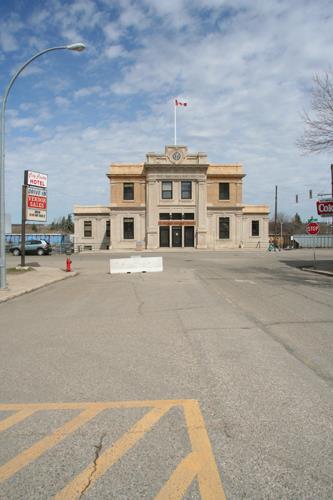
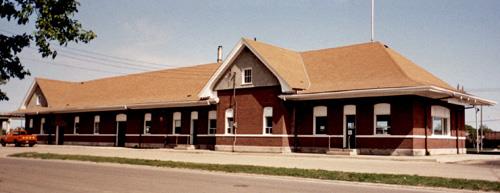 VIA Rail/Canadian National Railways StationPortage la Prairie, Manitoba
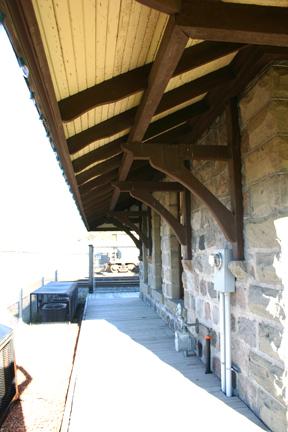
 Canadian Pacific Railway Station, BrandonBrandon, Manitoba
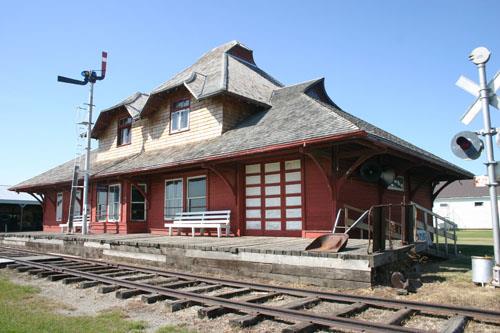
 Virden Canadian Pacific Railway StationVirden, Manitoba
 Morden Canadian Pacific Railway StationMorden, Manitoba
 Goderich Canadian Pacific Railway StationTown of Goderich, Ontario
From the Canadian Register of Historic Places, as last updated on December 12, 2025. The register’s text is shown word for word.