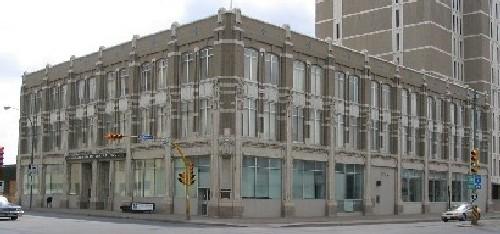
Willoughby and Duncan Building
Description
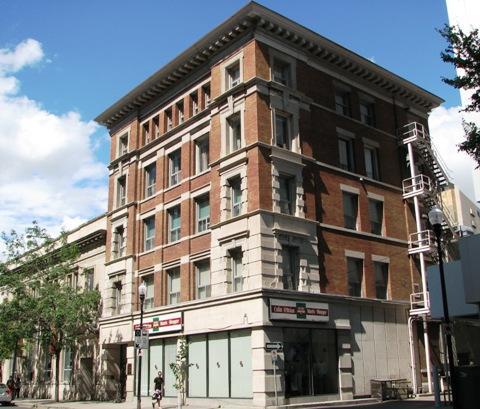
The Willoughby and Duncan Building is a Municipal Heritage property comprised of four commercial lots situated in Regina's downtown business district. The property features a 1909 four-storey brick building which fronts onto the east side of the Frederick W. Hill Mall. The designation applies specifically to the exterior façade of the structure.
Heritage Value
The heritage value of the Willoughby and Duncan Building lies in its contribution to the historic integrity of the 1800 block Scarth Street. The building remains on its original site in the commercial core of the city, an area which features the largest concentration of early commercial architecture in Regina’s downtown area.
The heritage value of the property also lies in the buildings association with Charles H. Willoughby, William H. Duncan, and Dr. Frances G. McGill. Mr. Willoughby and Mr. Duncan were successful businessmen, who together founded the Beaver Lumber Company. The pair had the building constructed in 1909, and maintained an office for their contracting firm on the property until 1922. Dr. Frances G. McGill was a noted pathologist and bacteriologist, director of the provincial laboratory for 20 years, and the first woman to be recognized as a member of the Royal Canadian Mounted Police. She resided on the second floor of the building in apartment 206 from 1918 – 1930.
Heritage value also resides in the property’s architecture. Designed in 1909 by F. Chapman Clemesha, the Willoughby and Duncan Building is one of the oldest remaining commercial buildings in Regina. Clemesha, one of the earliest architects to operate in the city, practiced in Regina until 1922. He was much better known for his residential and institutional architecture, and this is his only known commercial work in the city. Originally designed in the Chateau style with decorative end pavilions, the façade was “modernized” in the post Second World War era. Benefiting from a comprehensive façade enhancement program undertaken between 1994 and 1996, the building makes a significant contribution to the heritage character of the Frederick W. Hill Mall.
Source:
City of Regina Bylaw No. 10081 of 1999.
Character-Defining Elements
The heritage value of the Willoughby and Duncan Building resides in the following character-defining elements:
-those elements of the property which reflect its association with Charles H. Willoughby and William H. Duncan, including the exterior signage;
-those elements which reflect the remaining traces of the Chateau style as designed by F. Chapman Clemesha, including the dormers and sloped roof;
-those elements of the property which allow it to contribute to the historic integrity of the Frederick W. Hill Mall, including the location of the building on its original site.
Gallery
1 imageLocation
Loading map...
Similar Places
Heritage sites with similar characteristics