St. John's Anglican Church and Graveyard
Description
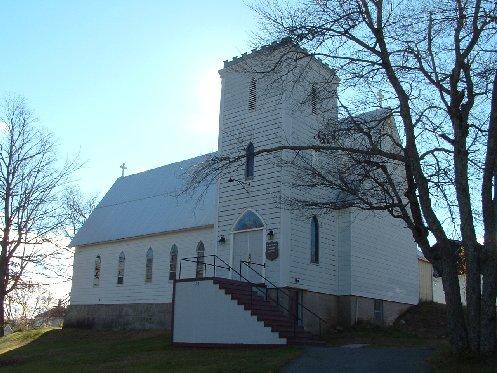
St. John’s Anglican Church is a grayish-brown concrete block church with Gothic Revival elements, situated on grounds that include an historic Anglican graveyard. These are located on Broad Road in the Town of Oromocto.
Heritage Value
St. John’s Anglican Church is designated a Local Historic Place for its importance as a longstanding place of worship for the Anglican denomination in the Oromocto region, as well as for its straightforward architectural design using manufactured concrete blocks that was in fashion for modest Canadian churches between the two World Wars.
The first St. John’s Anglican Church was a primitive building built in Oromocto in 1792. This was followed by a wood and stone structure built in 1863-1864. On September 30, 1919, a massive fire swept through the village of Oromocto, destroying many of its buildings, including the Anglican church and rectory. The current church building was built shortly thereafter, using the plans of a Rev. Frenchette. With precast concrete blocks as its exterior wall material and wooden frame X-trusses for the roof structure, the new church was consecrated by Bishop Richardson in June, 1921.
Source: Town of Oromocto, Town Office, Historic Places File, “St. John’s Anglican Church and Graveyard”
Character-Defining Elements
The character-defining elements that describe St. John’s Anglican Church and Graveyard include:
- the architectural design of the building, based on a typical English Gothic parish church form, with its steeply-pitched gable roof, square bell tower with main entry door, slight buttresses along the exterior walls, and its fenestration of pointed arch lancet windows and the triple lancet window behind the altar;
- its straightforward architectural design using manufactured concrete blocks that was in fashion for modest Canadian churches between the two World Wars;
- the structural framing of the roof, comprised of exposed wood x-bracing trusses with metal bolted brackets;
- the decorated interior liturgical elements, including a white marble baptismal font and a number of early 20th century stained glass windows;
- the rope pull in the bell tower that rings the church bell;
- the larger church grounds encompassing the rear graveyard;
- the gravestone of Robert Duncan Wilmot (1809-1891), a delegate to the Intercolonial Conference at London in 1866-67 and a Father of Confederation. A metal plaque to this effect was laid by the Historical Sites and Monuments Board of Canada near the base of his gravestone.
Gallery
3 imagesLocation
Loading map...
Similar Places
Heritage sites with similar characteristics