National Historic Site of Canada
Lansdowne Iron Works National Historic Site of Canada
Lyndhurst, Ontario
Also known as Lansdowne Iron Works, Forges de Lansdowne
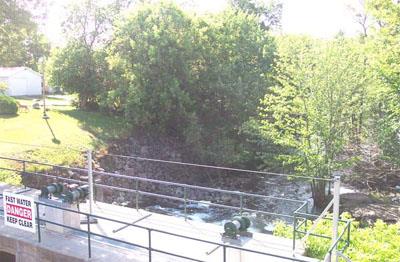
View of the east bank of the Gananoque River from the bridge. The designated place lies in the treed area in the centre of the photo
Photo: Parks Canada Agency / Agence Parcs Canada, 2005, (Heritage Research Associates Inc.)
- Built
- 1801–1812
- Recognized
- 1932
- By
- Government of Canada
The register’s text, word for word
Description
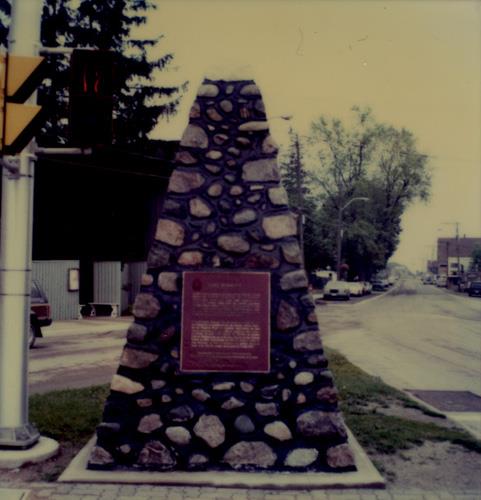
Lansdowne Iron Works National Historic Site of Canada is a foundry located on the eastern banks of the Gananoque River, just below the falls, in the village of Lyndhurst, Ontario. The few visible remains of the iron works include partial sections of its foundations and fragments of scattered slag. It is an archaeological site that includes remains of a furnace, a sawmill and associated works constructed by Wallis Sunderlin in 1801. When established, Lansdowne Iron Works was the first iron works in Upper Canada. The Historic Sites and Monuments Board of Canada erected a plaque and cairn to mark the site. Official recognition refers to two lots in the village of Lyndhurst, Ontario.
Heritage value
Lansdowne Iron Works was designated a national historic site of Canada in 1932 because:
- it is the site of the first iron works in Upper Canada.
The heritage value of Lansdowne Iron Works resides in its historical associations with the iron manufacturing industry in Upper Canada. While the existence of local ore was well-known and various petitions had been made to the government for the right to erect a foundry, it was not until 1801 that Wallis Sunderlin, a Vermont iron manufacturer, established the first iron works in Upper Canada at Furnace Falls. Sunderlin saw opportunity in the 7.3 metre natural waterfall, “Furnace Falls,” on the Ganonoque River and in the abundance of local iron ore. The works included a sawmill, a furnace stack 7.62 metres (25 feet) high, and a frame structure surrounding the furnace stack and a forge. The works, with a furnace for the production of cast iron and a forge for the manufacture of wrought iron goods was required by the area’s settlers. It was operated with limited success by Sunderlin and his associates until it was destroyed by fire in 1811. Sunderlin died during the War of 1812. Attempts in 1815-1816 to re-establish the works to supply the Kingston dockyard were ended with the agreement to limit armaments on the Great Lakes. The brick ruins visible on the site today are from the later Harvey gristmill (1881).
Character‑defining elements
Key elements that contribute to the heritage character of the site include: - its location in the village of Lyndhurst, Ontario; - its siting on the forested banks of the Gananoque River; - the integrity of any surviving or as yet unidentified archaeological remains which may be found within the site in their original placement and extent, including any remains from the furnace, sawmill, manufacturing equipment and iron goods, and from the smelting process; - viewscapes from the site toward the Gananoque River.
End of the register’s text
Location
County Rd. 33 - 50 m west of Lyndhurst Bridge at Cook Street, Lyndhurst, Ontario, Canada
44.54930° N, 76.12610° W
Get directions (opens in a new tab)Being on the register doesn’t make a place open to visitors. Many are private homes or businesses; please view them from the street.

Loading map…
Nearby
Similar places
Places whose register descriptions are closest to this one.
 Forges du Saint-Maurice National Historic Site of CanadaTrois-Rivières, Quebec
 FoundryMerrickville, Ontario
 Donaldson Site National Historic Site of CanadaChippawa Hill, Ontario
 Lanigan and Bowser Mill SiteRexton, New Brunswick
 Ruthven Park National Historic Site of CanadaHaldimand, Ontario
 Port Stanley National Historic Site of CanadaCentral Elgin, Ontario
From the Canadian Register of Historic Places, as last updated on December 12, 2025. The register’s text is shown word for word.