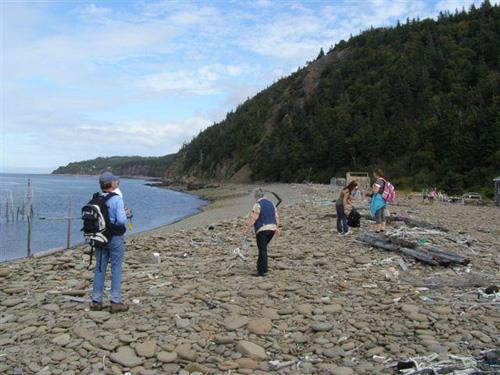
This view of Indian Beach looking north is not seen by many. The only access is by hiking a challenging trail. The cottage on the seawall is made from the stones of the seawall.
Photo: Larry Small 2009
- Recognized
- 2010
- By
- Local government
The register’s text, word for word
Description
Indian Beach is fronted by the Grand Manan Channel with extreme strong currents. The back of the seawall has a small pond and then towering 90-100 metre cliffs. The seawall itself is about 400 metres long and is only accessible by boat or hiking a challenging trail.
Heritage value
Indian Beach in Grand Manan is designated a Local Historic Place for its connection to our Island’s original seasonal settlers. The Passamaquoddy people would come to Indian Beach for the summer months to harvest porpoise and fish from the rich waters. They would dry the harvest on the seawall. They built camps to live in but did not spend the winters here. These seasonal patterns of the Passamaquoddy in the area were still active when documented in 1899 by W. F. Ganong. Existing pre-contact and early historical archaeological sites supply information on the seasonal habits of these groups and also suggest early permanent settlement of non-aboriginal groups. The area is also the source of many local folklore stories.
SourceGrand Manan Archives - Local Historic Places files
Character‑defining elements
The character-defining elements that describe Indian Beach include:
- natural seawall made all of stone washed up from the ocean;
- accessible only by boat or by hiking trail;
- high cliffs surrounding the area;
- small pond located between the seawall and the beach;
- pre-contact and early historical archaeological resources.
End of the register’s text
Location
Grand Manan, New Brunswick, Canada
44.78675° N, 66.80957° W
Get directions (opens in a new tab)Being on the register doesn’t make a place open to visitors. Many are private homes or businesses; please view them from the street.

Loading map…
Similar places
Places whose register descriptions are closest to this one.
From the Canadian Register of Historic Places, as last updated on December 12, 2025. The register’s text is shown word for word.