National Historic Site of Canada
Eglinton Theatre National Historic Site of Canada
Toronto, Ontario
Also known as Eglinton Theatre, Théâtre Eglinton
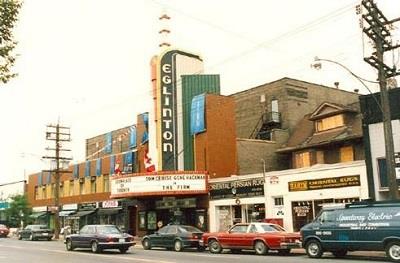
General view of Eglinton Theatre
Photo: Agence Parcs Canada \ Parks Canada Agency, J. Mattie, 1992.
- Built
- 1935–1936
- Recognized
- 1993
- By
- Government of Canada
The register’s text, word for word
Description
The Eglinton Theatre National Historic Site of Canada is a landmark in its setting on Eglinton Avenue West in the Forest Hill suburb of Toronto, Ontario. Constructed in the 1930s, the cinema is an elaborate and luxurious example of the Art Deco style in Canada. The front façade features the extensive use of multiple lighting fixtures, and a distinctively ornamented sign tower, with neon lettering and a three-stage pylon topped with a flashing neon ball. Official recognition refers to the building on the legal property on which it sat at the time of designation.
Heritage value
Eglinton Theatre was designated a national historic site of Canada in 1993 because:
- it is one of the best examples of the Art Deco style in Canadian theatre design;
- it is representative of the trend which began in the mid-1920s of building luxury movie theatres in the suburbs of major Canadian cities.
Designed by Toronto architects Kaplan & Sprachman, Eglinton Theatre represents a departure from previous theatre design, in that the styling and detailing are derived from the mainstream of architectural thought and practice, rather than from the world of theatre. This focus on architecture is illustrated by the Art Deco style of the building, especially in its sleek, uncluttered lines, stepped and overlapping forms, and emphasis on decorative detail.
In its location on Eglinton Avenue, within the 1920s Forest Hill suburb of Toronto, the Eglinton Theatre illustrates Toronto’s increasing suburbanization, and the nation-wide trend towards building new cinemas in suburban areas rather than in the central urban core of cities.
SourceHistoric Sites and Monuments Board of Canada, Minutes, November 1993.
Character‑defining elements
Key elements contributing to the heritage value of this site include:
— its location on Eglinton Avenue West in Toronto;
— its setting, in the 1920s suburb of Forest Hill;
— its irregular massing, with an integrated sign tower;
— its highly developed Art Deco style, demonstrating the three main phases of the movement – zigzag, streamlined and classical – in its exterior and interior detailing and decoration;
— the capacity of the original lighting fixtures on the exterior and interior to achieve architectural effects designed to reinforce other forms of ornamentation;
— its entrance façade, an assemblage of contrasting volumes, textures and materials;
— the arrangement of the entrance with shop fronts on either side of a box office surmounted by a sign tower, semi-circular marquee and box office;
— the profile and detailing of the sign tower, including its Art Deco form; concealed neon lighting, and three-stage pylon topped with a flashing neon ball crowning the sign tower;
— its construction using new architectural materials, including Catalin, Vitrolite, stainless steel, and Flexwood, used in the construction of signs, exterior facings, lighting fixtures and interior trim and fixtures;
— the simple, bold, Art Deco forms of the interior auditorium creating its Art Deco styling; including, the use of coloured neon and indirect incandescent lighting, a central, dropped ceiling panel, stepped up along its length to create a zigzag effect and curved at one end, the continuation of the centre ceiling banding down the walls to the proscenium arch, the rounded sidewalls, emphasized by a pleated frieze stepped at the sides, the zigzag patterned dado and pilaster-like divisions capped with red lights with pleated shades;
— interior detailing in Art Deco styles of the lobby, former waiting room, former foyer and former lounge;
— an etched and painted glass mural by artist John Clymer, depicting the three muses;
— the female nude statuary in the auditorium, representative of stylized Art Deco classicism.
End of the register’s text
Location
400 Eglinton Avenue West, Toronto, Ontario, Canada
43.70421° N, 79.41087° W
Get directions (opens in a new tab)Being on the register doesn’t make a place open to visitors. Many are private homes or businesses; please view them from the street.

Loading map…
Nearby
All 60 places in Toronto Montgomery's Tavern National Historic Site of Canada1.1 km
 Mount Pleasant Cemetery National Historic Site of Canada2.3 km
 Balmoral Fire Hall National Historic Site of Canada2.5 km · 1911
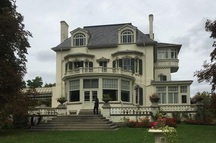 Spadina National Historic Site of Canada2.8 km · 1866
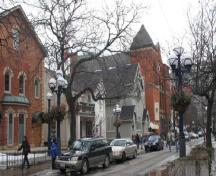 Heliconian Hall National Historic Site of Canada3.9 km · 1876
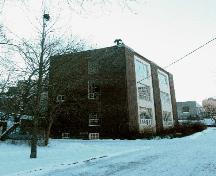 The Studio Building National Historic Site of Canada4 km · 1913
Similar places
Places whose register descriptions are closest to this one.
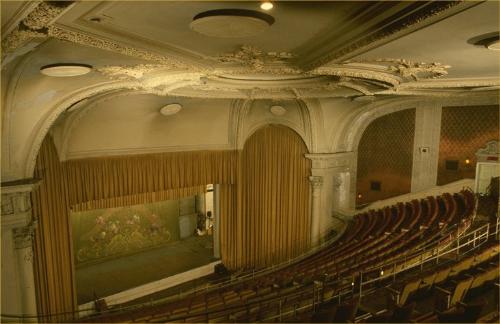 Elgin and Winter Garden Theatres National Historic Site of CanadaToronto, Ontario
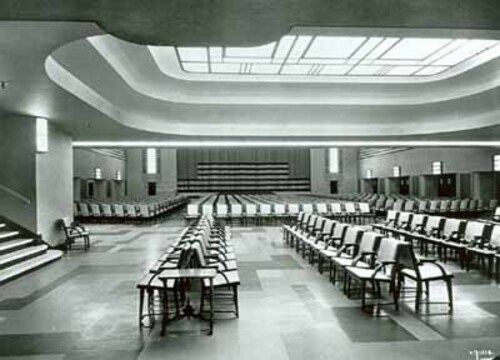 Eaton's 7th Floor Auditorium and Round Room National Historic Site of CanadaToronto, Ontario
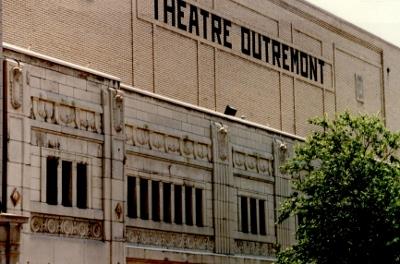 Outremont Theatre National Historic Site of CanadaMontréal, Quebec
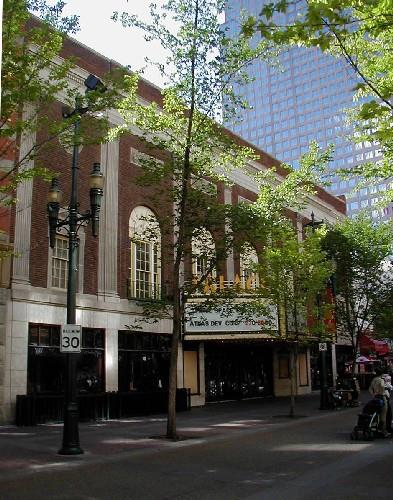 Palace Theatre National Historic Site of CanadaCalgary, Alberta
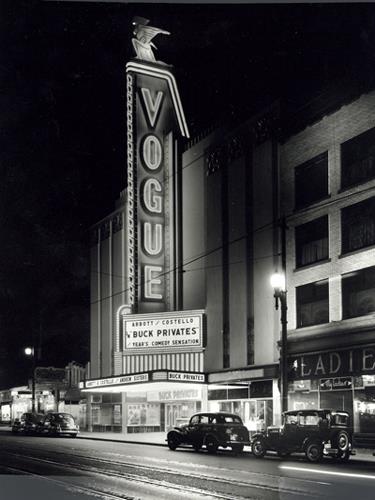 Vogue Theatre National Historic Site of CanadaVancouver, British Columbia
 Metropolitan Theatre National Historic Site of CanadaWinnipeg, Manitoba
From the Canadian Register of Historic Places, as last updated on December 12, 2025. The register’s text is shown word for word.