National Historic Site of Canada
Montgomery's Tavern National Historic Site of Canada
Toronto, Ontario
Also known as Montgomery's Tavern, Taverne de Montgomery
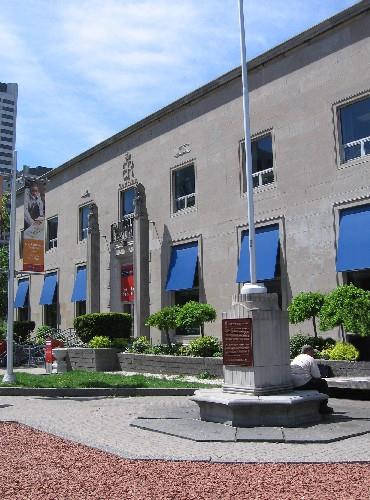
Detail view of Montrgomery's Tavern, showing the location of the Historic Sites and Monuments Board of Canada plaque, 2006.
Photo: Parks Canada Agency / Agence Parcs Canada, 2006.
- Recognized
- 1925
- By
- Government of Canada
The register’s text, word for word
Description
Montgomery’s Tavern National Historic Site of Canada is located in Toronto at the intersection of Yonge Street and Montgomery Avenue. The site, currently occupied by a post office, is marked by a Historic Sites and Monuments Board of Canada plaque affixed to the base of a monument and flagpole situated to the north of the building. There are no known extant resources from the original tavern and its exact dimensions and footprint in relation to the post office remain unknown. Official recognition refers to a five-metre radius around the Historic Sites and Monuments Board of Canada plaque.
Heritage value
Montgomery’s Tavern was designated a national historic site of Canada in 1925 because:
- it was the headquarters of William Lyon McKenzie, leader in the Upper Canada Rebellion;
- it was the scene of a skirmish on December 7, 1837, which resulted in the collapse of the rebellion; and
- the rebellion was an important factor in bringing about the legislative union of Upper and Lower Canada, and the permanent establishment in Canada of responsible government.
In 1837, unable to establish fair government representation through political means, William Lyon Mackenzie, a reformer, newspaper editor, and the first mayor of Toronto (elected in 1834), assembled a group of moderates and radicals in an attempt to overthrow the existing government. Making Montgomery’s Tavern, located north of Toronto’s current boundaries, his headquarters, Mackenzie began his rebellion on December 5 when he and approximately 800 ill-equipped and untrained rebels began a march southward. The local militia repelled them before they could reach the city, and on December 7, Lieutenant Governor Sir Francis Bond Head ordered 1,000 militia and volunteers under Colonel James FitzGibbon to strike back. FitzGibbon’s forces were routed Mackenzie’s near Montgomery’s Tavern the same day, and the rebellion collapsed. The tavern was burnt down the same day. Though the rebellion was quelled, it was nevertheless instrumental in bringing about the establishment of responsible government in Canada, as well as a legislative union between Upper and Lower Canada, in 1841.
SourceHistoric Sites and Monuments Board of Canada, Minutes, May 1925, May 2007.
Character‑defining elements
Key elements contributing to the heritage value of this site include:
- its location north of Toronto, at the intersection of Yonge Street and Montgomery Avenue;
- its setting in an urban environment, where the monument and Historic Sites and Monuments Board of Canada plaque is located;
- the integrity of any surviving or as yet unidentified archaeological remains which may be found within the site in their original placement and extent.
End of the register’s text
Location
2384 Yonge Street, Toronto, Ontario, M4R, Canada
43.70944° N, 79.39917° W
Get directions (opens in a new tab)Being on the register doesn’t make a place open to visitors. Many are private homes or businesses; please view them from the street.

Loading map…
Nearby
All 60 places in Toronto
Similar places
Places whose register descriptions are closest to this one.
 Montmorency Park National Historic Site of CanadaQuébec, Quebec
 Fort York National Historic Site of CanadaToronto, Ontario
 Her Majesty's / St. Paul's Chapel of the Mohawks National Historic Site of CanadaBrantford, Ontario
 Bank of Upper Canada Building National Historic Site of CanadaToronto, Ontario
 Glengarry House National Historic Site of CanadaCornwall, Ontario
 Dundurn Castle National Historic Site of CanadaHamilton, Ontario
From the Canadian Register of Historic Places, as last updated on December 12, 2025. The register’s text is shown word for word.