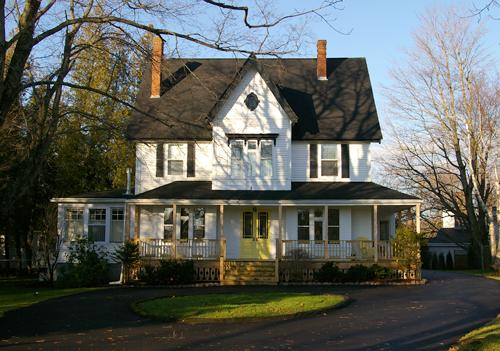
Cleasby
Description
Cleasby is a two-storey Picturesque residence from the mid-19th century. This residence is built on stone-wall foundations and sits on the east side of Rothesay Road facing northwest.
Heritage Value
Cleasby is designated a Local Historic Place for its architectural merit, for its association with its builder and for its association with its former owners. John J. Munroe was a carpenter and a businessman who established a trunk and valise manufacturing business on Princess Street in nearby Saint John. He built Cleasby around the year 1855. In 1869, John J. Munroe sold Cleasby to John Livingston. Throughout his career, Livingston was editor of several newspapers in Saint John and throughout the rest of Canada. Starting in 1871, the successive owners of Cleasby were Egerton R. Burpee, who was responsible for the westward extension of the European and North American Railway from Saint John to Bangor, General Darius B. Warner, US Consul in Saint John and John Morris Robinson manager of the Bank of Nova Scotia.
Cleasby is also architecturally significant as a good example of Gothic Revival-inspired Picturesque residential architecture from the mid-19th century. The home exhibits traditional elements of this style such as a steeply gabled roof, gingerbread trim and label window headers.
Source: Rothesay Living Museum, Historic Places file “Cleasby”
Character-Defining Elements
The character-defining elements that describe Cleasby include:
- two-storey rectangular massing;
- steeply pitched gable roof;
- gingerbread trim on wide eaves;
- eave brackets;
- two gable dormers;
- clapboard siding;
- two-storey box window;
- single-storey bay window;
- label window headers;
- stone foundation walls;
- one-and-a-half storey ell.
Gallery
1 imageLocation
Loading map...
Similar Places
Heritage sites with similar characteristics