Municipal Heritage Site
Betsey Ramsay's Grave
Riverton, Manitoba
Also known as Borden No. EfLf-2
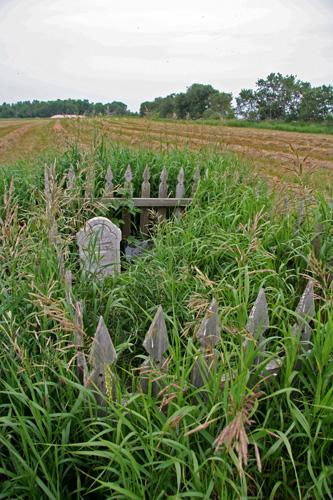
Contextual view, from the south, of Betsey Ramsay's Grave, Riverton area, 2006
Photo: Historic Resources Branch, Manitoba Culture, Heritage and Tourism, 2006
- Recognized
- 1989
- By
- Local government
The register’s text, word for word
Description
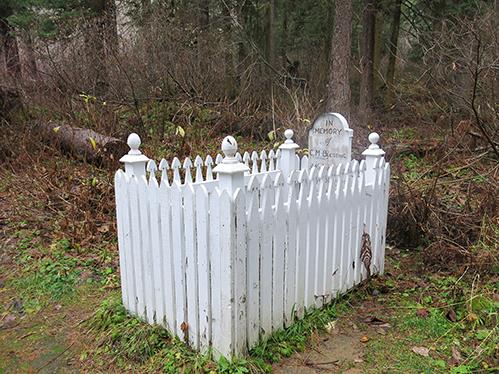
Betsey Ramsay's Grave consists of the burials of Betsey and John Ramsay, two modest grave markers and a small picket fence that encloses them. The site is situated a short distance from the Lake Winnipeg shoreline, just south of Riverton, and is surrounded by cultivated fields. The municipal designation applies to the gravestones, fence and small parcel of land on which they stand.
Heritage value
Betsey Ramsay's Grave is important for the rural community around Riverton, a potent and poignant reminder of the area's early interaction between Aboriginal peoples and Icelandic settlers, of a smallpox epidemic that decimated the Interlake region in 1876, of a love story that still inspires local attention, and of traditional Icelandic folklore beliefs. The gravesite is the only tangible link to Betsey and John Ramsay, prominent members of a local Saulteaux Aboriginal band who reached out in the mid-1870s to newly-arrived Icelandic immigrants, educating the settlers in winter survival techniques and providing meat to hungry families. The gravesite for Betsey Ramsay also is the only known marked resting place in the area that recalls the 1876 smallpox epidemic, a devastating episode that took the lives of both First Nations peoples and Icelanders. That Betsey's burial is marked with a fine marble tablet recalls the heroic efforts of John Ramsay who undertook a pilgrimage of more than 200 kilometres to obtain the memorial from Lower Fort Garry, making it the first marker of its kind in the area. The situation of the grave on the shores of Lake Winnipeg reinforces the depth of loss aroused in John Ramsay by the death of his wife, who was said to have loved the sounds associated with the lake. The site has also assumed importance as a reminder of traditional Icelandic folklore, and of that culture's belief in the power of dreams. Local legend asserts that the short white picket fence that traditionally encloses the gravesite was the manifestation of a dream in which Trusti Vigfusson, who in 1910 hunted on the land on which the gravesite sits, was directed by John Ramsay's ghost to erect a protective fence.
SourceRural Municipality of Bifrost By-law No. 1-89, September 13, 1989
Character‑defining elements
Key elements that define the site character of Betsey Ramsay's Grave include:
- the relatively remote and isolated location, close to the western shore of Lake Winnipeg, and in an open setting within grain fields and grasses
Key elements that define the physical characteristics of the site include:
- the gravesites of the remains of Betsey and John Ramsay, placed side by side
- the placement, facing south, of the fine nineteenth-century marble gravestone with original engravings marking the resting place of Betsey Ramsay, and beside it of the granite stone, of recent design, marking the grave of John Ramsay
Key elements that define the traditional Icelandic folkloric characteristics of the site include:
- the presence of a white picket fence around the burial site
End of the register’s text
Location
Riverton, Manitoba, R0B, Canada
50.96972° N, 96.93611° W
Get directions (opens in a new tab)Being on the register doesn’t make a place open to visitors. Many are private homes or businesses; please view them from the street.

Loading map…
Nearby
Similar places
Places whose register descriptions are closest to this one.

From the Canadian Register of Historic Places, as last updated on December 12, 2025. The register’s text is shown word for word.