Municipal Heritage Designation (Part IV)
Beth-Emmanuel British Methodist Episcopal Church
City of London, Ontario
Also known as B.M.E. Church, African Methodist Church, Fugitive Slave Chapel
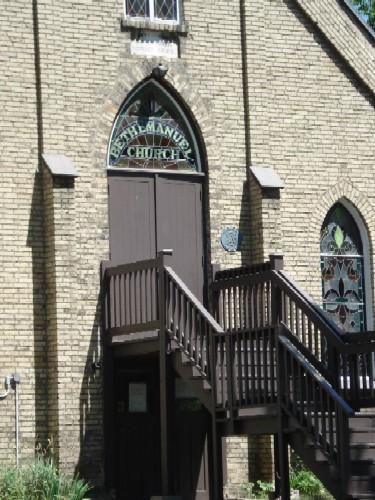
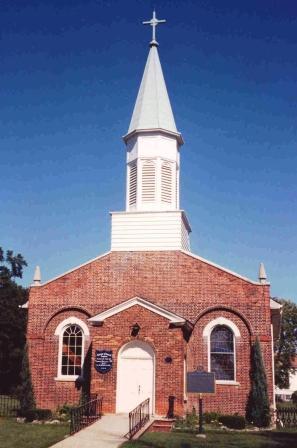
Of note is the gothic window above the door that displays the Church's name.
Photo: Kendra Green, 2007.
- Recognized
- 1983
- By
- Local government
The register’s text, word for word
Description
The Beth-Emmanuel British Methodist Episcopal Church is located at 430 Grey Street, on the north side of Grey Street between Colborne and Maitland Streets, in the City of London. The single-storey white-brick church was constructed between 1868 and 1871.
The property was designated, by the City of London, in 1983, for its historic value or interest, under Part IV of the Ontario Heritage Act (By-law L.S.P. – 2657-240).
Heritage value
The Beth-Emmanuel British Methodist Episcopal church is the oldest surviving church, for the Black community, in the City of London. At the time the congregation was founded, the Black community was large and prosperous. The community was centred on land around the south side of the fork of the Thames River. The congregation worshiped at 275 Thames Street under the name African Methodist Episcopal Church until 1856 when the name was changed to the British Methodist Episcopal Church. The congregation built the present white-brick, Gothic Revival structure at 430 Grey Street between 1868 and 1871. In later years, the building was raised for the construction of a basement.
Some noteworthy individuals are associated with the church. These include John Brown, the abolitionist, who preached at the Thames Street Church in 1858 before his ill-fated raid on Harper's Ferry the following year. Later, Richard B. Harrison, a noteworthy local actor, attended the church as well as his brother, the Reverend William Harrison. In more recent times, the late Paul Lewis, one of London's best-loved citizens, was an official of the congregation.
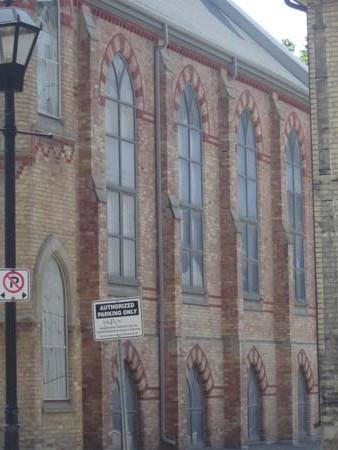
The Beth-Emmanuel British Methodist Episcopal church is an example of Gothic Revival architecture. Characteristic of this style are the symmetrically-placed pointed-arched gothic windows, some which have been constructed with stained glass. The rectangular-shaped floor plan and steep roofline of the church are also reminiscent of the Gothic Revival style. Unique to this church are the symmetrical protruding brick columns that emphasise the narrow window openings.
SourceCity of London By-law No. L.S.P.-2657-240; “Beth Emmanuel, historic London church, gets a facelift from friends”, article in Londoner, July 20, 2005.
Character‑defining elements
Character defining elements that contribute to the heritage value of the Beth-Emmanuel British Methodist Episcopal Church include its:
- continued use as a site of worship
- inscription of the church's name in the gothic window above the front door, commemorating the founding of the congregation
- exterior elevations of white-brick construction and symmetrical protruding brick columns
- pointed-arched gothic windows, and their symmetrical locations
- roofline and steep roof-pitch
- rectangular floor plan
End of the register’s text
Location
430, Grey Street, City of London, Ontario, N8Y, Canada
42.97988° N, 81.23512° W
Get directions (opens in a new tab)Being on the register doesn’t make a place open to visitors. Many are private homes or businesses; please view them from the street.

Loading map…
Similar places
Places whose register descriptions are closest to this one.
 First Christian Reformed ChurchCity of London, Ontario
 Holland Emmanuel Historical ChurchVictoria, Manitoba
 Emmanuel Anglican ChurchPortland, Ontario
 Salem Chapel, British Methodist Episcopal Church National Historic Site of CanadaSt. Catharines, Ontario
 Christian Baptist ChurchNewmarket, Ontario
 Christ Church Amherstburg (Anglican)Amherstburg, Ontario
From the Canadian Register of Historic Places, as last updated on December 12, 2025. The register’s text is shown word for word.