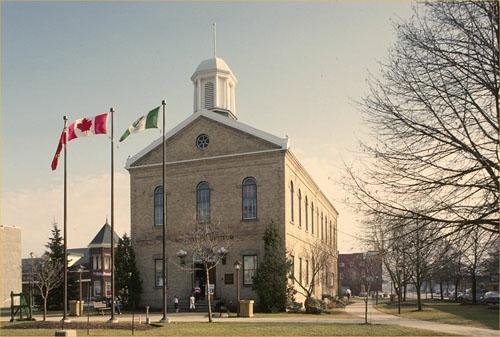
Wolfe Island Township Hall National Historic Site of Canada
Also known as: Wolfe Island Township Hall, Wolfe Island Township Hall National Historic Site of Canada, Mairie du canton de Wolfe Island
Description
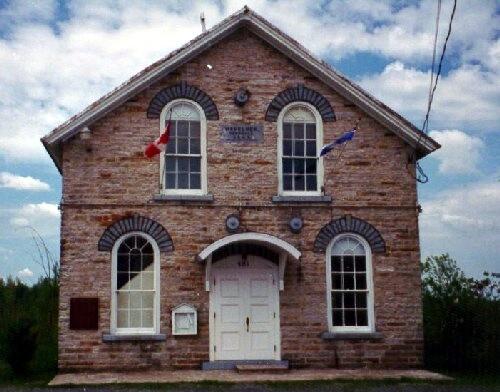
Wolfe Island Township Hall National Historic Site of Canada is an elegant small stone building located on Wolfe Island, near Kingston, Ontario. It is a simple structure built in the mid 19th century as a meeting place for the community and the local municipal council. The designation refers to the building on its legal property.
Heritage Value
Wolfe Island Township Hall was designated a national historic site in 1984 because:
- it survives as a symbol of the development of self-government in rural Ontario; and,
- its fine, hammer-dressed limestone construction and handsome Italianate detailing make it an unusually sophisticated example of its type.
Wolfe Island Township Hall National Historic Site of Canada is a sophisticated public hall designed by Kingston architect Edward Horsey. It was built in 1859 to provide a meeting place for the local council after the 1849 Municipal Act enabled self-government in rural Ontario. Its single large room also provided a convenient local assembly and meeting hall. Since then, the interior has been sub-divided as a municipal office and council chamber.
Sources: Historic Sites and Monuments Board of Canada, Minutes, Nov. 1984, Nov. 1991
Character-Defining Elements
Key features contributing to the heritage value of this site include:
- its single-storey rectangular massing under a medium-pitched roof with chimneys;
- its Italianate styling, notably its symmetrically organized elevations with regularly spaced windows with central entry, heavy returned eaves and ornate roof brackets, prominent panelled main door with overlight, oculus on the gable facade, segmentally arched window and door openings, prominent quoins, stacked chimneys, and high foundation;
- its finely crafted hammer-dressed limestone construction;
- surviving evidence of its original interior layout as a single room;
- surviving original interior materials and furnishings;
- its siting in a landscaped lot;
- its continuous use as a municipal facility.
Gallery
1 imageLocation
Loading map...
Similar Places
Heritage sites with similar characteristics