Municipal Heritage Designation (Part IV)
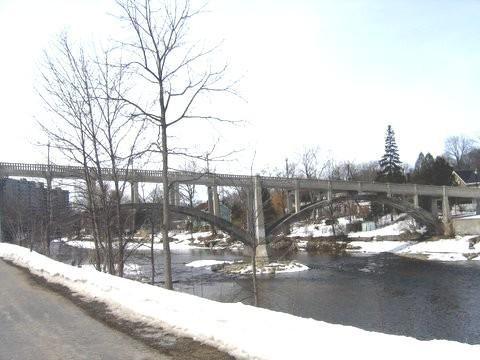
Stone Road Bridge
City of Guelph, Ontario
Also known as Stone Road East Bow Truss, McQuillan's Bridge
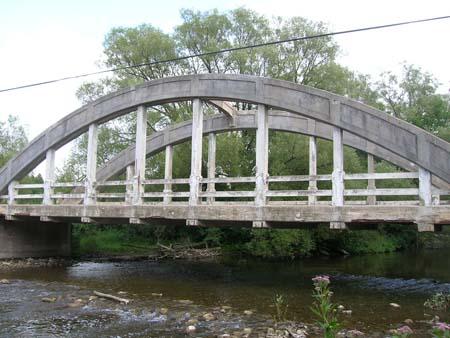
Of note are the eight vertical members.
Photo: Lyndsay Haggerty, 2007.
- Built
- 1916
- Recognized
- 2004
- By
- Local government
The register’s text, word for word
Description
The Stone Road Bridge spans the Eramosa River on Stone Road East, between Victoria Road South and Watson Road South, in the City of Guelph. The single-span concrete bowstring arch truss bridge was constructed in 1916.
The property was designated, by the City of Guelph, in 2004, for its cultural heritage value or interest, under Part IV of the Ontario Heritage Act (By-law (2004)-17357A). The Stone Road Bridge has also been listed on the Ontario Heritage Bridge list, a list of provincially significant bridges maintained by the Ministry of Culture.
Heritage value
Stone Road Bridge spans the Eramosa River, a Canadian Heritage River and serves as an important gateway marker on Stone Road East.
The Stone Road Bridge is an important link to the city's pattern of growth and development. The bridge was built under the direction of Wellington County Engineer A. W. Connor, in 1916, in order to accommodate the increased settlement and agricultural production, in the area. It replaced an earlier wooden bridge, known as the McQuillan Bridge, due to the proximity of the site to land cleared and settled by the McQuillan family. The McQuillan family was one of the area's first settlers and their land later became part of the Ontario Agricultural College. Stone Road, on which the bridge is located, was named for F.W. Stone, another settler of the area. He was an importer of thoroughbreds and built a house that became the Ontario Agricultural College's first building.
The Stone Road Bridge is an early example of a reinforced concrete bowstring arch truss bridge. It is the only example of a concrete bowstring arch truss bridge within the City of Guelph. The bridge's bowstring design became popular in the 1920s and 1930s, as it required minimal material, was simple to install and could easily accommodate vehicular traffic.
Local contractor Charles Mattaini, who built over 50 bridges between 1905 and 1920, is credited with building the Stone Road Bridge. The spans measure 21.3 metres and the width accommodates one lane of traffic. The arches, composed of eight vertical members, are connected by a single cross beam.
The Stone Road Bridge, located on Stone Road East spanning the Canadian Heritage River, the Eramosa River, serves as an important gateway marker.
SourceCity of Guelph By-law (2004)-17357A; City of Guelph Inventory of Heritage Structures, Stone Road East, 1993; Stone Road Bridge, Built Heritage and Cultural Landscape Impact Assessment, Archaeological Services Inc., 2001.
Character‑defining elements
Character defining elements that contribute to the heritage value of the Stone Road Bridge include its:
- reinforced concrete bowstring arch truss construction
- eight vertical members
- chamfered and dimpled balustrades
- original dimensions of 21.3 metre span, eight arches and one lane road width
- reinforced concrete deck
- cross beam tying the two arches together
- 1916 date of construction inscription
- location spanning the Eramosa River, a Canadian Heritage River
End of the register’s text
Location
0, Stone Road, City of Guelph, Ontario, N1L, Canada
43.54710° N, 80.19733° W
Get directions (opens in a new tab)Being on the register doesn’t make a place open to visitors. Many are private homes or businesses; please view them from the street.

Loading map…

Similar places
Places whose register descriptions are closest to this one.
From the Canadian Register of Historic Places, as last updated on December 12, 2025. The register’s text is shown word for word.