St. Stephen Post Office National Historic Site of Canada
Description
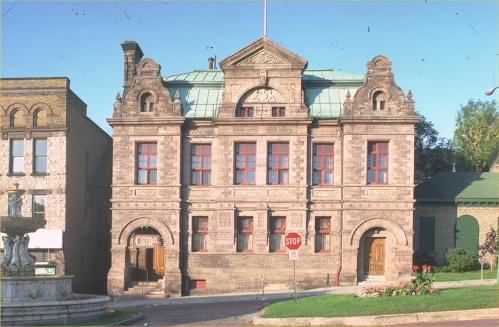
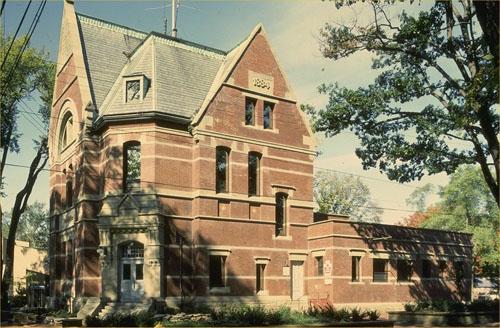
The St. Stephen Post Office National Historic Site of Canada is a splendid two-and-a-half-storey brick and stone structure executed in the Romanesque Revival style, featuring contrasting colours and textures of materials, a symmetrical elevation with paired entrances and a prominent central gable with decorative carving. Prominently sited on one of the town’s major streets, it now serves as the town hall. The designation refers to the interior and exterior of the building on its lot at the time of designation in 1983.
Heritage Value
St. Stephen Post Office was designated a national historic site of Canada in 1983 because:
- it is representative of small urban post offices by Thomas Fuller.
Built from 1885 to 1887, this building was constructed to house the local post office, customs offices and internal revenue offices. Designed under the federal government’s chief architect Thomas Fuller, the structure is one of a series of buildings erected with the aim of establishing a visible federal presence throughout the country. It is a fine example of late 19th-century design in its picturesque composition and in the varied colours and textures of the exterior building materials. The round-arched doors and windows and the decorative carving show the influence of the Romanesque Revival style. Since 1965, this building has served as the St. Stephen town hall.
Sources: Historic Sites and Monuments Board of Canada, Minutes, June 1983, November 1988.
Character-Defining Elements
Aspects of this site which contribute to its heritage value include:
- its prominent setting within the sympathetic context of an urban area of the small community of St. Stephen;
- those elements which speak to the qualities of a small urban post office, namely its conspicuous setting in the community, its public accessibility signalled by the prominent main doors and the vestiges of the interior layout and materials surviving from its time as a post office;
- those elements which speak to the building’s architectural merit and integrity, namely, its elevation and massing, its Romanesque Revival design as illustrated by its use of contrasting red brick and pale stone, its generous door and window trim, and the pediment with decorative carving.
Gallery
2 imagesLocation
Loading map...
Similar Places
Heritage sites with similar characteristics