Saint-Antoine l'Ermite Church
Description
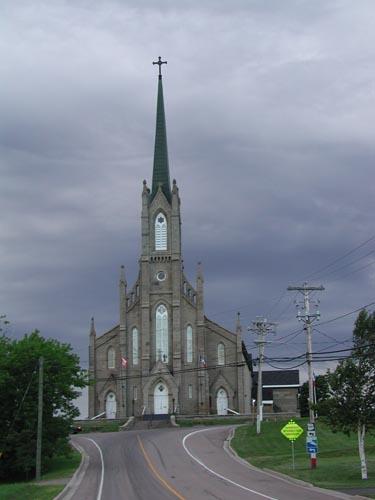
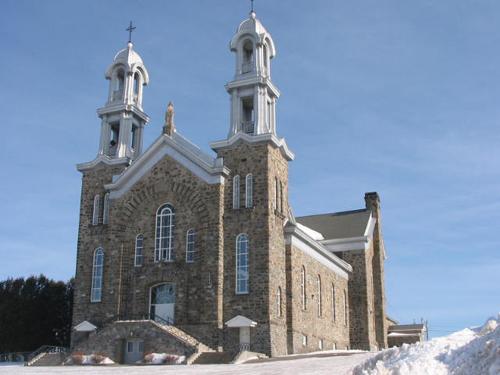
Saint-Antoine l'Ermite Church consists of a large Neoclassical stone church and a lot on de l'Église Avenue in Saint-Antoine.
Heritage Value
Saint-Antoine l’Ermite Church is designated a Local Historic Place for its association with the lasting presence of religion in the village and for its architecture.
Built in the Neoclassical style, Saint-Antoine l’Ermite Church continues to be the principal place of worship for the Catholic community. Since its construction in 1923, it has been the tallest and most dominant structure in the village. In 1919, it was decided to build a new church to accommodate the growing congregation. Noted Acadian architect René-Arthur Fréchet and Father Philippe Hébert of Notre-Dame drew up the plans for what would be the largest stone church in the area at that time. Under the direction of Father Allain, the transportation of rocks from a quarry in Notre-Dame started in 1920. No fewer than 1,500 loads of stones were required in order to begin building the church in 1923.
Saint-Antoine l’Ermite Church also represents a good example of Neoclasscial religious architecture from the early 20th century in Saint-Antoine. The church exhibits this style through such elements as the Roman arch door and window openings, rectangular massing and symmetrical façade with central bell tower. The church sits on a mature landscaped lot.
Sources: Village of Saint-Antoine Municipal Office, file A7, "church and presbytery"
Character-Defining Elements
The character-defining elements that describe Saint-Antoine l'Ermite Church include:
- lot with mature landscaping;
- rectangular massing of the structure;
- stone walls;
- symmetrical façade with central bell tower;
- Roman arch door and window openings;
- mosaic windows and wooden doors, most dating back to the construction of the church in 1923;
- wooden pews inside the church;
- altar and statues dating from the completion of the interior of the church;
- immense interior columns supporting the building.
Gallery
2 imagesLocation
Loading map...
Similar Places
Heritage sites with similar characteristics