Classified Federal Heritage Building
Saint-Antoine de Padoue Church
Batoche, Saskatchewan
Also known as Église Saint-Antoine-de-Padoue
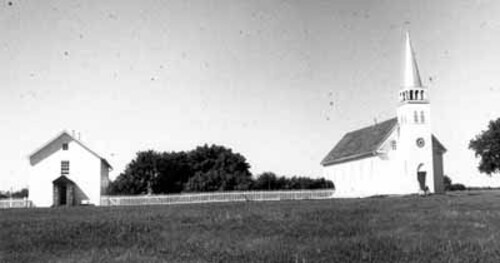
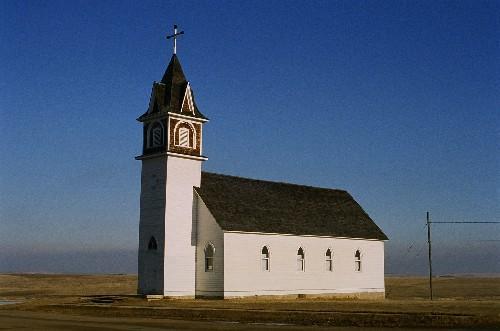
General view of the Saint-Antoine de Padoue Church
Photo: Parks Canada | Parcs Canada, 1982
- Built
- 1883–1885
- Recognized
- 1991
- By
- Government of Canada
The register’s text, word for word
Description
The Saint Antoine de Padoue Church is located adjacent to the Saint Antoine de Padoue Rectory in Batoche National Historic Site of Canada. This small, modest church has a front tower, a gothic arched doorway, and pointed gothic windows. It was built using a Red River frame construction technique and is clad in horizontal wood siding. This church dominates its historic landscape. The designation is confined to the footprint of the building.
Heritage value
The Saint Antoine de Padoue Church is a Classified Federal Heritage building because of its historical associations, and architectural and environmental values.
Historical value:
The Saint Antoine de Padoue Church was the site of events during the Battle of Batoche. Consequently, it is a symbol of the cultural heritage of the Métis population, and represents two historical themes. First, it represents the early activities and influence of the Oblate order (the dominant Roman Catholic order in the Northwest). Second, it represents the clash of Métis and European settler cultures, which resulted in the North-West Rebellion of 1885. The two buildings are directly associated with people such as Louis Riel and his Métis council, and with Major-General Frederick Middleton and the Northwest Field Force, who played significant roles in the Battle of Batoche. The church remained an important institution in Métis communities after 1885, acting as a stabilizing element and cultural centre in an area that was becoming increasingly populated by settlers.
Architectural value:
The Saint Antoine de Padoue Church is a very good example of a typical 19th-century rural church. The building exhibits a modest Gothic Revival style, featuring an arched doorway, pointed windows, front tower and gabled roof with returned eaves. Its architectural value lies in its good quality craftsmanship including the usage of a Red River frame construction technique that was particularly well-suited to structures such as churches which required long, open interior spaces.
Environmental value:
The Saint Antoine de Padoue Church is a dominant structure in its rural surroundings and sets the tone for the Batoche National Historic Site of Canada.
SourceShannon Ricketts, The Saint-Antoine-de-Padoue Church, Batoche National Historic Site, Batoche, Saskatchewan, Federal Heritage Building Review Office Building Report 88-160; The Saint-Antoine-de-Padoue Church, Batoche National Historic Site, Batoche, Saskatchewan, Heritage Character Statement, 88-160.
Character‑defining elements
The following character-defining elements of the Saint Antoine de Padoue Church should be respected.
Its good aesthetic, very good functional design, and good craftsmanship and materials as evidenced in:
-its modest, clapboard structure with a slender steeple rising above its roofline;
- its arched, Gothic Revival doorway and windows, front tower and simple gable roof with returned eaves;
- the simple pleasing lines of the church, its fine proportions and balanced composition;
- its hall-church plan design, with six Gothic Revival style windows along each side wall of the nave, and a balcony at the back of the nave supported by posts and reached by a single-flight stairway;
- its Red River frame construction technique, which consists of logs laid horizontally and slotted into grooved vertical timbers at each end;
- its restored interior with its period furnishings, such as wooden pews.
The manner in which the Saint Antoine de Padoue Church reinforces the historic character of its Batoche National Historic Site of Canada setting and is a familiar, local landmark, as evidenced by:
- the site of the church, which has been restored to its 1896-1897 appearance;
- its role in reinforcing the cultural heritage of the local Métis population, as one of the only buildings to have survived in the area from the pre-1885 era;
- its spatial and historic relationship with the Saint Antoine de Padoue Rectory;
- its prominent status in its surrounding environment.
End of the register’s text
Location
Batoche, Saskatchewan, Canada
52.75227° N, 106.11750° W
Get directions (opens in a new tab)Being on the register doesn’t make a place open to visitors. Many are private homes or businesses; please view them from the street.

Loading map…
Nearby
All 4 places in Batoche
Similar places
Places whose register descriptions are closest to this one.
 Saint-Antoine l'Ermite ChurchSaint-Antoine, New Brunswick
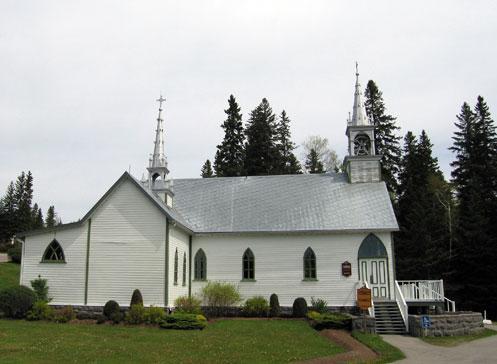 Chapelle Saint-Antoine-de-PadoueLac-Bouchette, Quebec
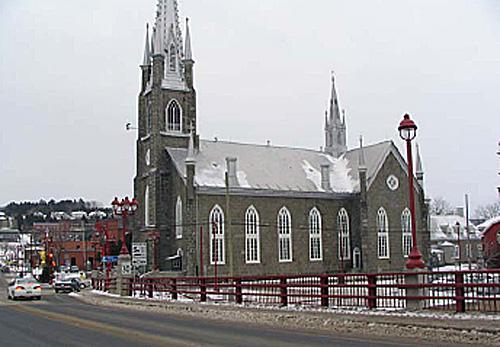 Church of Sainte-Marie National Historic Site of CanadaSainte-Marie, Quebec
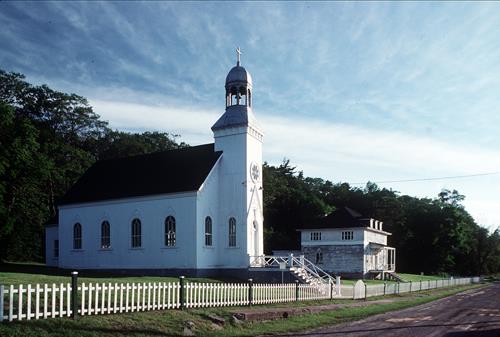 Building 48Montmagny, Quebec
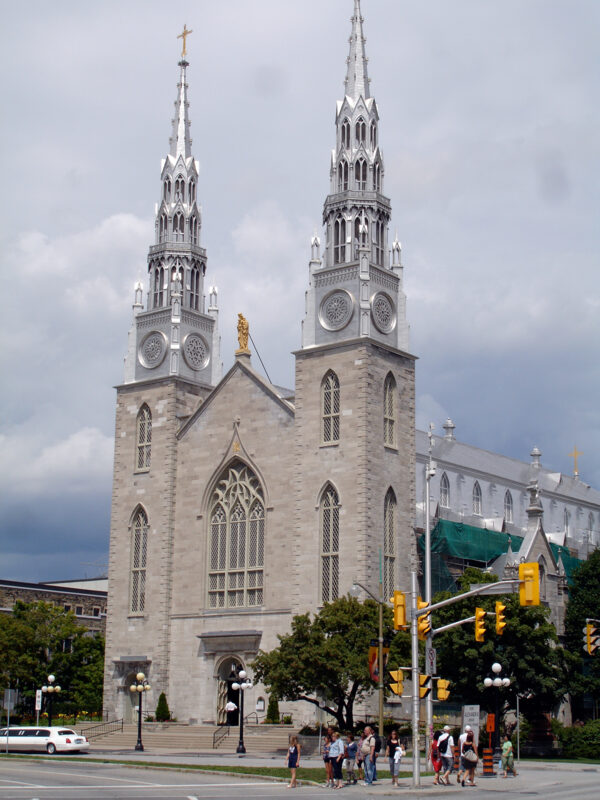 EnhancedNotre-Dame Roman Catholic Basilica National Historic Site of CanadaOttawa, Ontario
 St. Patrick's Roman Catholic ChurchHerbert, Saskatchewan
From the Canadian Register of Historic Places, as last updated on December 12, 2025. The register’s text is shown word for word.