Men's House
Also known as: Men's House, Quartiers des employés
Description
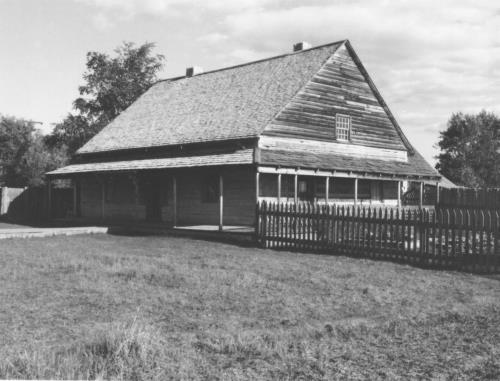
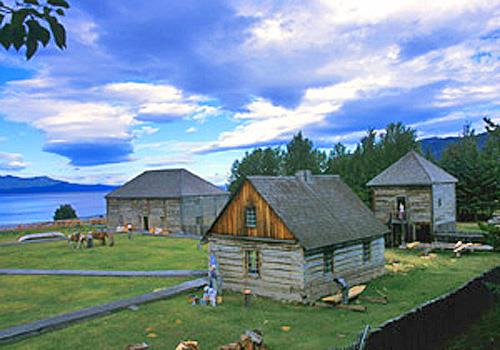
Located at Fort St. James National Historic Site, the Men’s House is a rectangular one-and-a-half storey log building with a gable roof. Its front façade has two large windows and a single door. The designation is confined to the footprint of the building.
Heritage Value
The Men’s House is a Recognized Federal Heritage Building because of its historical associations, and its architectural and environmental value.
Historical Value
Fort St. James played a key role in the development of transportation and communications in northern British Columbia. It provided a base from which the North West Company, and later the Hudson’s Bay Company (HBC), traded with local First Nations peoples, in particular the Carrier tribe. The Men’s House was constructed the first year of a five-year program aimed at renewing the trading establishment at Stuart Lake. As one of the oldest buildings in the vicinity of the present-day town of Fort St. James, it also represents a significant phase in the history of the community.
Architectural Value
The Men’s House is a good example of high-quality log construction. It is among four other buildings on the site that constitute the largest group of extant wood fur trade structures in Canada. It is simple and plainly finished, reflecting its function and the status of its inhabitants.
The Environmental Value
The Men’s House was relocated between 1884 and 1889 and, while its immediate context has undergone changes since that time, the early character of its setting is today largely intact. The building reinforces the cultural landscape of the restored and reconstructed fort.
Sources:
Men’s House, Fort St. James National Historic Site, Fort St. James, Victoria, British Columbia, Heritage Character Statement, 89-113.
Character-Defining Elements
The following character-defining elements of the Men’s House should be respected, for example:
Its illustration of the significant role of the fur trade in Canadian history and its changing requirements over time as reflected in:
-Its current role, as an integral part of the Fort St. James National Historic Site, in the
interpretation of the Canadian fur trade, and more precisely, as a Men’s House that
served other functions (employees’ residence, schoolhouse, and rental building), in
affirming the need for such structures to adapt to the changing requirements of the fort.
Its simple design and high-quality horizontal log construction, for example:
-Its simple form and its arrangement of large windows with a single door.
-Its original horizontal, log exterior walls with dovetailed corners, which are largely
intact.
Its spatial relationship with its immediate context and the fort as a whole as evidenced by:
-Its visibility within the historic site due to the open area around the building.
-Its relationship with the surrounding buildings, which is reinforced by the wooden
platforms, fences, and other features that make up the restored and reconstructed cultural
landscape of the Fort St. James National Historic Site.
Gallery
1 imageLocation
Loading map...
Similar Places
Heritage sites with similar characteristics