National Historic Site of Canada
Fort St. James National Historic Site of Canada
Fort St. James, British Columbia
Also known as Fort St. James
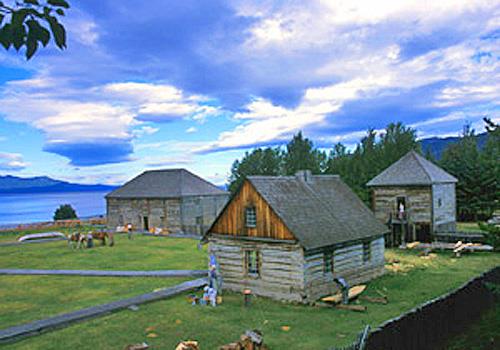
General view of Fort St. James showing the sites, orientation and layout of these buildings in relation to archaeological remains of other buildings and structures within the fort, 2003.
Photo: Parks Canada Agency / Agence Parcs Canada, D. Houston, 2003.
- Built
- 1806–1896
- Recognized
- 1948
- By
- Government of Canada
The register’s text, word for word
Description
Fort St. James National Historic Site of Canada is a former fur trade post located in the village of Fort St. James at the southern tip of Stuart Lake, British Columbia. It is a restored compound located beside a lake between the Nak’azkli First Nations Reserve and the business district of the village. The site includes buildings, archaeological resources and reconstructed components.
Heritage value
Fort St. James was declared a national historic site in 1948 to commemorate the role of the present post and its predecessors on Stuart Lake (1806-1952)
- in the fur trade of the Pacific Slope,
- as an important centre of trade and cooperation with the First Nations of the Pacific Slope,
- as the chief trading post in north-central British Columbia and the administrative centre of the District of New Caledonia,
- as an important link in transportation and communications in northern British Columbia.
The heritage value of Fort St. James National Historic Site lies in its historical associations as illustrated by its siting and surviving historical resources. Fort St. James was founded by the North West Company to conduct trade with the Carrier First Nation and after 1821, was operated by the Hudson’s Bay Company. From 1826-1862 it was the headquarters of the Hudson's Bay Company’s New Caledonia District, while in later years it served as base for transportation links to northern British Columbia. Over this period, it occupied a loosely defined, evolving site on the shore of Stuart Lake. The post closed in 1952, four years after it had been declared a National Historic Site.
It was subsequently outfitted for public visitation, an activity that included both restoration and reconstruction to the 1896 period. The fort contains archaeological resources from the period 1806-1952 as well as original buildings (the General Warehouse, 1888-89; Fish Cache, 1888; the Men’s House, 1884/85, 1888/89; Officer’s Dwelling, 1884/85; and the Dairy, present in 1896).
SourceHistoric Sites and Monuments Board of Canada, Minutes, 1963 and 1971; Commemorative Integrity Statement, July 1996.
Character‑defining elements
Key features contributing to the heritage value of this site include:
- its location on the Pacific Slope at the tip of Stuart Lake;
- the footprint of the fort as it evolved during the 1906-1952 period;
- the General Warehouse in its large two-storey rectangular massing under a hipped roof, its regularly spaced apertures, minimal detailing, its Red River frame construction, its interior layout, surviving early materials and historic graffiti, orientation and location within the fort in relation to other buildings, the water and the wharf;
- the Fish Cache in its small, square massing under a pagoda roof, its design inspired by traditional First Nations structures, its lack of windows, its use of wooden construction materials, its interior layout, and its orientation and location within the fort in relation to other buildings;
- the Men’s House in its 1 ½-storey rectangular massing under a pitched roof, its central door and flanking windows, its minimal detailing, its interior layout and surviving early materials, its use of wooden construction materials including shingle roof and log laid in Red River frame, its orientation and location within the fort in relation to other buildings and functions;
- the Officer’s Dwelling in its single-storey rectangular massing under a pitched roof, its minimal
detailing, its interior layout, surviving early materials, its use of wooden materials and construction technology such as the shingle roof and log Red River frame construction, its orientation and location within the fort in relation to other buildings and functions, its view of the water;
- the Dairy in its rectangular massing, large proportions and pitched roof, its use of wooden construction materials and techniques such as its shingle roof and log in Red River frame construction, its interior layout, surviving early materials, its orientation and location within the fort in relation to other buildings;
- the sites, orientation and layout of these buildings in relation to archaeological remains of other buildings and structures within the fort;
- archaeological remains of fur trade activity both above and below ground, both on-site and removed during site investigation and stored in Parks Canada collections;
- unobstructed access and viewscapes to Stuart Lake, to fish extraction locations, and to the historic shoreline trail;
- the location of the site beside the Nak’azkli First Nations Reserve;
- the presence of indigenous vegetation between the fort and the site of the village of Fort St. James;
- its visibility from the Nak’azkli First Nations Reserve, and the lake.
End of the register’s text
Location
PO Box 1148, Fort St. James, British Columbia, V0J, Canada
54.43520° N, 124.25659° W
Get directions (opens in a new tab)Being on the register doesn’t make a place open to visitors. Many are private homes or businesses; please view them from the street.

Loading map…
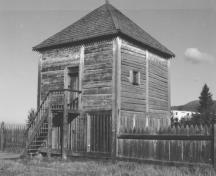
Similar places
Places whose register descriptions are closest to this one.
 Fort Victoria National Historic Site of CanadaVictoria, British Columbia
 Fort St. Joseph National Historic Site of CanadaSt. Joseph Island / Île St. Joseph, Ontario
 Fort Langley National Historic Site of CanadaLangley, British Columbia
 Fort William National Historic Site of CanadaSt. John's, Newfoundland And Labrador
 Fort Alexandria National Historic Site of CanadaAlexandria, British Columbia
 Fort Amherst National Historic Site of CanadaSt. John's, Newfoundland And Labrador
From the Canadian Register of Historic Places, as last updated on December 12, 2025. The register’s text is shown word for word.