Registered Historic Place
Lime Kiln - Former Campbell Property
Lower Montague, Prince Edward Island
Also known as Former Duncan M. Campbell Lime Kiln
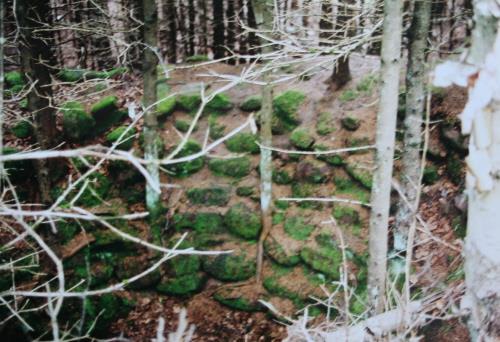
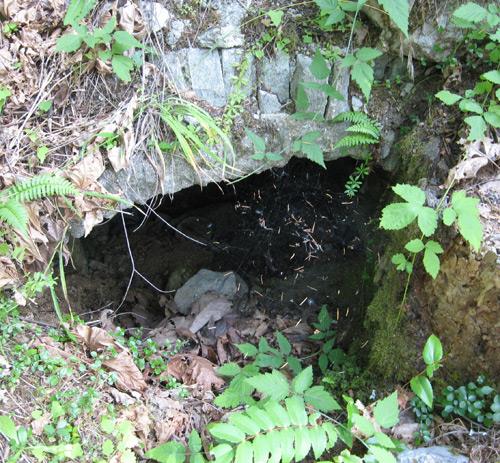
Showing remains of lime kiln with moss on stones
Photo: Province of PEI, Donna Collings, 2005
- Recognized
- 2010
- By
- Province of Prince Edward Island
The register’s text, word for word
Description
The remains of this former lime kiln are located in a densely wooded area. Field stones, now covered in green moss, are still in their original places giving the former kiln its round appearance. The interior or the kiln has been filled in by falling leaves and pine needles.
Heritage value
The kiln is valued as an example of one of several lime kilns which were constructed in the Three Rivers area for the production of calcining limestone which local farmers used on their fields to reduce the acidity of the soil and improve their production.
In 1863, the land where this kiln is located was owned by James D. Campbell. Meacham's 1880 Atlas shows the kiln situated on the property of Duncan M. Campbell. The property was later purchased by Wilfred Waterworth, who would later sell it to Bert Haneveld, who established a successful apple orchard.
Lime kilns were used since ancient times to turn limestone into lime which could then be applied for agricultural purposes to the soil. Limestone was not common to Prince Edward Island, but it was often used in the holds of ships as ballast. When vessels loaded their cargo, the limestone was often removed and left on the wharfs where farmers collected it for a minimal charge.
These large limestone pieces were then broken up and burned in lime kilns to produce the white lime powder which was valuable for their fields. These kilns were usually built near waterways and measured six feet in diameter and nine feet deep with a shale rock bottom. They were carved into the side of a hill and lined with sandstone. A grate was placed at the bottom of the kiln onto which was placed a layer of wood, then a layer of limestone, and then a layer of coal. When this burned at a very high temperature, it produced the lime powder which could be raked out of the kiln through an opening.
Today, all that remains of this kiln are the remnants of the sandstone lining arranged in a circular pattern. The site is important as a reminder of the importance of lime kilns to the history of agriculture in the area. Another kiln is located on the adjacent property once owned by Alex Campbell, but it was made from cut sandstones, not the ordinary field stones from which this example was created.
Source: Culture and Heritage Division, PEI Department of Tourism and Culture, Charlottetown, PE C1A 7N8
File #: 4310-20/K8
Character‑defining elements
The heritage value of the kiln is shown in the following character-defining elements:
- the remaining field stones of the kiln lining arranged in a circular pattern and built into the side of a hill
- the exposed nature of the site which is now overgrown and located in a wooded area
End of the register’s text
Location
494 Route 17, Lower Montague, Prince Edward Island, Canada
46.16436° N, 62.61479° W
Get directions (opens in a new tab)Being on the register doesn’t make a place open to visitors. Many are private homes or businesses; please view them from the street.

Loading map…
Similar places
Places whose register descriptions are closest to this one.
 Lime KilnHighlands, British Columbia
 Wood Drying KilnHunter River, Prince Edward Island
 180 Mount Edward Road / Wooldridge QuarryCharlottetown, Prince Edward Island
 Kingzett Lake Lime Kiln and Ceramic WellShawnigan Lake, British Columbia
 Campbell Summer HomeStanley Bridge, Prince Edward Island
 Victoria ParkCharlottetown, Prince Edward Island
From the Canadian Register of Historic Places, as last updated on December 12, 2025. The register’s text is shown word for word.