CPR Telegraph Office
Also known as: CPR Telegraph Office, Lockhart's Art Rooms, Lockhart's Art Rooms
Description
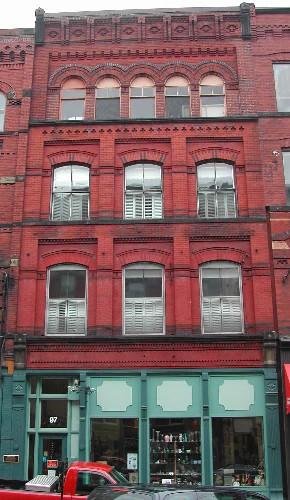
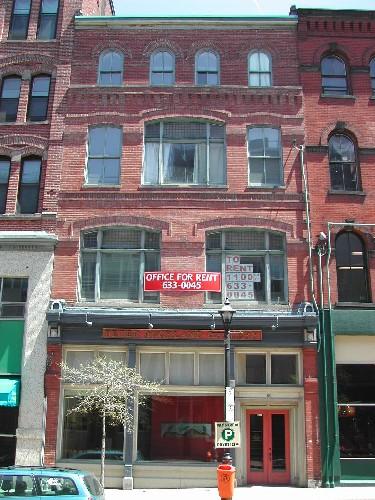
Built circa 1878, the CPR Telegraph Office is a four-storey brick Italianate commercial building. It is located on Prince William Street within the boundaries of the Trinity Royal Heritage Conservation Area of the City of Saint John.
Heritage Value
The CPR Telegraph Office is designated a Local Historic Place for its architecture and for its association with its former occupants.
The CPR Telegraph Office is recognized as an expression of the significance of a Saint John commercial district. It is one of a collection of government, commercial and residential buildings that were built between 1877 and 1881 after two-thirds of the City of Saint John were destroyed by the Great Saint John Fire of 1877. This building serves as a reminder of that fire and the strong will of the residents of Saint John to rebuild the city. The brick architecture sent a message that the city would be more fire resistant in the future and the elements and design in this building as well as the rest of the collection demonstrate that the city was going to be rebuilt as well or better than the city that was lost. The CPR Telegraph Office is an example of commercial Italianate architecture from Saint John’s rebuilding period. The building is located within the Trinity Royal Heritage Conservation Area, officially recognized by the City of Saint John in 1982.
The CPR Telegraph Office is also recognized for its association with the Walker family. This building was built for James Walker shortly after the fire in 1877. In 1915 the building was obtained by his son, John Douglas Walker, and the building remained in the Walker family until 1954.
The CPR Telegraph Office is also recognized through its association with the occupants who have conducted business here. One of the original occupants of this building was William Lockhart. He was known as the leading auctioneer in Saint John for many years. He conducted his business here until 1893.
William Hawker occupied space in CPR Telegraph Office. In 1895, he moved into this building for want of more space and he began to manufacture the Hawker remedies. He later sold his line of remedies to the Canadian Drug Company. Hawker's three sons all became druggists. Hawker died in 1937.
One influential lawyer that conducted business here was James King Kelley. He moved into this building in 1899. In 1912, he was named King's Council. He was a member of the Saint John City Council and later secretary. He was one of the leading workers in having erected the Saint John County Hospital, and for child welfare, he was one of the first in the community to advocate the "Cottage Home", each cottage with its "mother", to give the children the benefit of a real home atmosphere, as he claimed this was a much better atmosphere than living in a large institutional building. Mr. Kelley was also an advocate of a prison farm.
The Canadian Pacific Telegraph Company used this building from 1899 until 1912. The McAlpine City Directory was published here from 1924 until 1939.
Source: Planning and Development Department - City of Saint John
Character-Defining Elements
The character defining elements that describe CPR Telegraph Office include:
- rectangular four-storey massing filling width of the lot;
- brick exterior walls;
- symetrical placement of rectangular windows;
- corbel bands at the roof-line;
- bracketed roof-line cornice;
- continuous sandstone lintels and projecting sills;
- decorative brick work under fourth-storey windows;
- sandstone pediment entablatures over second-storey windows.
The character defining elements that describe the storefront include:
- recessed wooden door with glass panel in centre bay;
- transom windows and sidelights;
- broad cornice;
- pilasters;
- wooden bulkheads.
Gallery
3 imagesLocation
Loading map...
Similar Places
Heritage sites with similar characteristics