National Historic Site of Canada
Burlington Heights National Historic Site of Canada
Hamilton, Ontario
Also known as Burlington Heights, Burlington-Heights
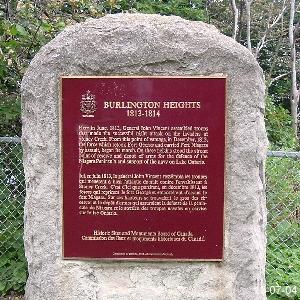
View of the monument.
Photo: Parks Canada/Parcs Canada 2005
- Built
- 1813
- Recognized
- 1929
- By
- Government of Canada
The register’s text, word for word
Description
Burlington Heights National Historic Site of Canada is located on an isthmus, 2.5 kilometres long and rising some 30 metres above lake level, separating Cootes Paradise from the harbour in Hamilton, Ontario. Crossed by railway lines, major highways and a canal, the site currently features a number of parks, a cemetery and botanical gardens. Official recognition refers to the high ground bounded by the southern boundaries of Dundurn Park and Hamilton Cemetery, and a 95-metre contour line.
Heritage value
Burlington Heights was designated a national historic site of Canada in 1929 because:
- during the War of 1812, it was a key position and supply depot for the defence of the Niagara peninsula and support of the navy on Lake Ontario;
- it was the assembly point for the successful British attack on the American force at Stoney Creek in June 1813 and for the recovery of Fort George and taking of Fort Niagara in December 1813.
Forced out of Fort George after the American forces landed at the mouth of the Niagara River, the British, under General John Vincent, retreated to Burlington Heights. Rising 30 metres above the lake and straddling roads from Niagara, Amherstburg, and those leading to York, the Heights were a natural strongpoint for the British to regroup. It was from here that General Vincent organized the successful night attack on June 5-6 1813, led by Lieutenant-Colonel John Harvey, on the pursuing American forces encamped at Stoney Creek. Following the American retreat back to Fort George, General Vincent fortified the Heights with two lines of earthworks across the peninsula, gun batteries, blockhouses, barracks and storehouses. A strongpoint on the road to the east, Burlington Heights became a major supply depot for the forces in the Niagara peninsula; and at times, ensured safe anchorage for the Lake Ontario fleet. In December 1813, the Heights were once again used as the assembly point for another campaign against the Americans, in which the British recaptured Fort George and captured Fort Niagara. Although the military continued to view the site as defensible following the end of the War of 1812, the buildings were allowed to deteriorate, and today the site is occupied by various attractions, including the Dundurn Castle National Historic Site of Canada and part of the Royal Botanical Gardens National Historic Site of Canada.
SourceHistoric Sites and Monuments Board of Canada, Minutes, 1929, 1930, 2008.
Character‑defining elements
Key elements contributing to the heritage value of this site include:
- its location on an isthmus 30 metres above Lake Ontario, separating the Hamilton Harbour from Cootes Paradise;
- its setting in a parkland landscape adjacent in the city of Hamilton, featuring numerous historic buildings and sites, including the 1837 Desjardins canal, Dundurn Castle National Historic Site of Canada, and part of the Royal Botanical Gardens National Historic Site of Canada;
- the integrity of evidence of General Vincent’s fortifications, located on the grounds of Dundurn Castle, including an earthwork and gun platform within the courtyard, a powder magazine in the cellar’s fur vault, a defensive earthwork on the south lawn in line with the earthwork in the courtyard, and a defensive earthwork on the north lawn;
- the integrity of evidence of the first line of defense, today extending across the cemetery into Harvey Park;
- the integrity of any surviving or as yet unidentified archaeological remains which may be found within the site in their original placement and extent;
- viewscapes between the heights, Cootes Paradise and the harbour.
End of the register’s text
Location
610 York Boulevard, Hamilton, Ontario, L8R, Canada
43.27193° N, 79.88588° W
Get directions (opens in a new tab)Being on the register doesn’t make a place open to visitors. Many are private homes or businesses; please view them from the street.

Loading map…
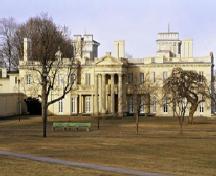 Dundurn Castle National Historic Site of Canada300 m · 1834
 Hamilton Custom House1.6 km · City of · 1858
 Former Hamilton Customs House National Historic Site of Canada1.6 km · 1858
 Canadian National Railway Station1.8 km · 1929
 Former Hamilton Railway Station (Canadian National) National Historic Site of Canada1.8 km · 1929
 Hamilton CNR Station1.9 km · 1929
Similar places
Places whose register descriptions are closest to this one.
 Battle of Stoney Creek National Historic Site of CanadaHamilton, Ontario
 Battlefield Monument – Stoney Creek Battlefield ParkHamilton, Ontario
 Battlefield of Fort George National Historic Site of CanadaNiagara-on-the-Lake, Ontario
 Queenston Heights National Historic Site of CanadaNiagara-on-the-Lake, Ontario
 Ridgeway Battlefield National Historic Site of CanadaRidgeway, Ontario
 Fort Drummond National Historic Site of CanadaNiagara-on-the-Lake, Ontario
From the Canadian Register of Historic Places, as last updated on December 12, 2025. The register’s text is shown word for word.