National Historic Site of Canada
St. Anne's Anglican Church National Historic Site of Canada
Toronto, Ontario
Also known as St. Anne's Anglican Church, Église anglicane St. Anne
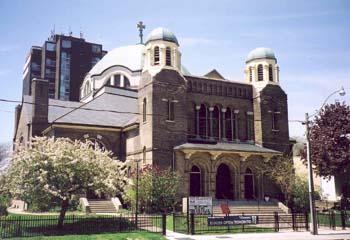
View of the façade of St. Anne's Anglican Church, showing its stepped roofline culminating in a large octagonal central dome.
Photo: Ontario Ministry of Culture / Ministère de la Culture de l'Ontario
- Built
- 1907–1908
- Recognized
- 1996
- By
- Government of Canada
The register’s text, word for word
Description
St. Anne’s Anglican Church National Historic Site of Canada is located in a central residential neighbourhood of Toronto, Ontario. Built in 1907-1908 in the Byzantine Revival style, St. Anne’s Anglican Church contains a remarkable cycle of paintings by ten prominent Canadian artists. The elaborate interior mural decorations, designed by J.E.H. MacDonald, cover the walls and ceiling of the apse, the main arches, the pendentives and the central dome. The cycle combines narrative scenes, written texts, as well as decorative plasterwork and detailing accentuating the architectural lines of the building. Official recognition refers to the building and its interior decorative work on its legal lot.
Heritage value
St. Anne’s Anglican Church was designated a national historic site of Canada in 1996 because:
- it contains a remarkable cycle of paintings, executed in 1923, by ten prominent artists, including three members of the Group of Seven, under the supervision of J.E.H. MacDonald;
- its cycle of paintings belongs to the revival of mural decoration that emerged in the last quarter of the 19th century and is a manifestation of the Arts and Crafts movement which sought to ally architecture with the sister arts of painting and sculpture;
- the St Anne’s decorative cycle draws upon the motifs, colours and the artistic conventions of Byzantine art, and is integral to the church’s architectural style.
In 1923 J.E.H. MacDonald, having accepted a commission to paint and decorate St. Anne’s, brought in nine more artists including two other members of the Group of Seven, Fred Varley and Frank Carmichael, along with an architect, William Rae, who co-directed the decoration of the interior. In keeping with the design of the building, MacDonald drew on the motifs, colours and artistic conventions of Byzantine artistic traditions, adapting their character to reflect a contemporary Canadian setting.
Lawrence Skey, rector from 1902 to 1933, was the project’s motivating force and was directly involved with the original decision to build in a Byzantine style. This reflected his support for an ecumenical movement that advocated unification with other Protestant denominations. Architect W. Ford Howland’s design was intended to evoke the early Byzantine period, before the Christian church had split into its subsequent numerous denominations. Howland was an associate with Burke and Horwood, a Toronto architectural firm known for their designs of Protestant churches. The art and architecture of St. Anne’s Anglican Church illustrates a distinctive period in Anglican Church history.
SourceHistoric Sites and Monuments Board of Canada, Minutes, November 1996.
Character‑defining elements
Key elements that contribute to the heritage character of the site include:
- its location in a downtown neighbourhood within the city of Toronto;
- its Greek cross plan with narthex, nave, transepts and chancel;
- its stepped roofline culminating in a large octagonal central dome;
- its brick exterior facing;
- the entry façade with three arched doorways flanked by domed bell towers;
- the large, open interior volume with central dome rising on pendentives;
- the use of rich interior finishes including brick facing, marble chancel steps, Caen stone columns, mosaic, and stained glass;
- the original placement, materials and design of doors and windows;
- the paintings comprising eleven narrative scenes, four large images on the pendentives beneath the central dome, and seven smaller images which run in a horizontal band around the upper wall of the chancel, notably; the painting of the Nativity by F.H. Varley, the painting of the Crucifixion by J.E.H. MacDonald, the painting of the Resurrection by H.S. Stansfield, and, works by Frank Carmichael, Thoreau MacDonald, Neil Mackechie, Arthur Martin, H.S. Palmer, H.S. Stansfield, and sculptors Frances Loring and Florence Wyle;
- the chancel ceiling decoration of gold leaf with vine leaf and grape motifs, and Christian symbols including the Tree of Life.
End of the register’s text
Location
270 Gladstone Avenue, Toronto, Ontario, M6J, Canada
43.65028° N, 79.43098° W
Get directions (opens in a new tab)Being on the register doesn’t make a place open to visitors. Many are private homes or businesses; please view them from the street.

Loading map…
Nearby
All 60 places in Toronto St. Anne's Churchwithin 100 m · 1907
 Masaryk Hall1 km · City of · 1898
 Fort York Armoury2.4 km · 1935
 Fort York National Historic Site of Canada2.4 km · 1813
 Kensington Market National Historic Site of Canada2.4 km · 1815
 Gouinlock Buildings / Early Exhibition Buildings National Historic Site of Canada2.9 km · 1904
Similar places
Places whose register descriptions are closest to this one.
 St. Jude's Anglican Church National Historic Site of CanadaBrantford, Ontario
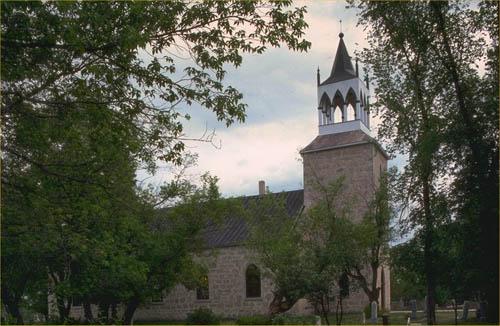 St. Andrew's Anglican Church National Historic Site of CanadaSt. Andrews, Manitoba
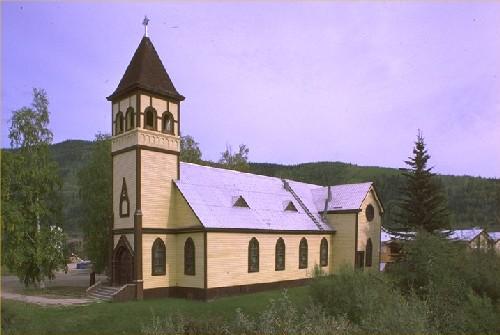 St. Paul's Anglican Church National Historic Site of CanadaDawson, Yukon
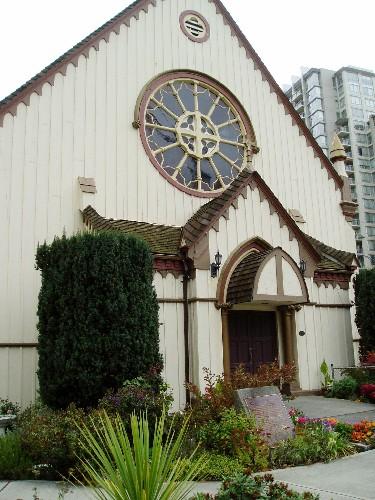 Church of Our Lord National Historic Site of CanadaVictoria, British Columbia
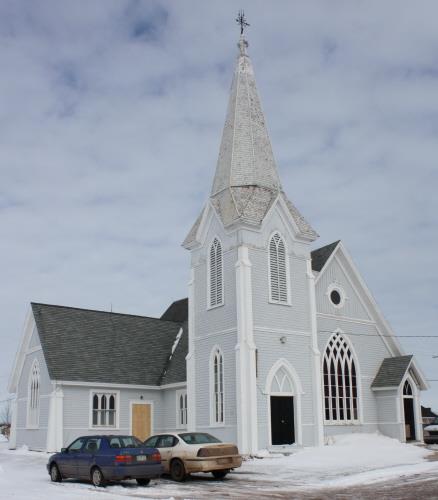 St. Anne's Roman Catholic ChurchLennox Island, Prince Edward Island
 Church of Sainte-Marie National Historic Site of CanadaSainte-Marie, Quebec
From the Canadian Register of Historic Places, as last updated on December 12, 2025. The register’s text is shown word for word.