St. Andrew's Cathedral
Also known as: St. Andrew's Cathedral, Cathedrale St. Andrew's
Description
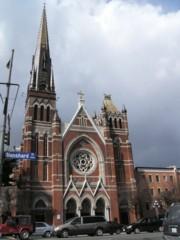
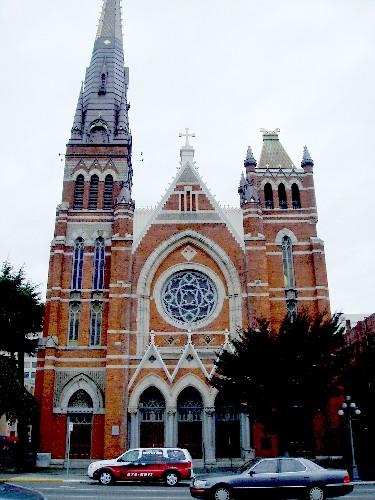
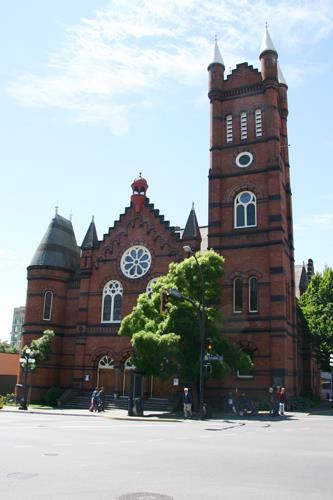
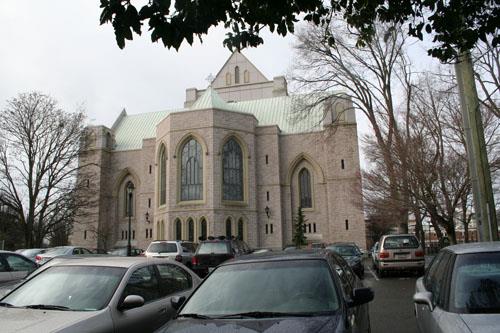
The St. Andrew's Cathedral is the Roman Catholic cathedral for the diocese of Victoria, B.C. It is a landmark in the centre of the city, with a tall vertical spire, asymmetrical twin-towered design, circular stained-glass windows and a mix of red brick, grey stone and slate exterior masonry.
The cathedral is recognized by the City of Victoria through its heritage register and is designated a National Historic Site of Canada.
Heritage Value
St. Andrew's Cathedral has historic, cultural, spiritual and aesthetic significance for B.C.'s Francophone community because it represents Francophone and Metis religious history in B.C. and for its design and construction by Francophone architects and builders.
Constructed in 1892, St. Andrew's Cathedral is valued for being the first major masonry structure built for the Roman Catholic church in Victoria. As well as representing the architectural evolution of the church's building styles, the cathedral reflects the influence of the large Francophone population in the city. Its predecessor, a wood-framed building on nearby Humbolt Street, was relocated behind St. Ann's Convent school and re-purposed as St. Ann's Chapel.
The cathedral is important for its association with its Francophone architects Maurice Perrault and Albert Mesnard, well-known church architects from Montreal. A duplicate of a parish church in Vaudreuil- Dorion, Quebec, the church has aesthetic value through its use of the French Gothic Revival style typical of Quebec churches. This is seen in the twin tower bases, tall, slender spire, asymmetrical facade, and three-arched entryway. Other features such as the contrasting colours of the exterior masonry, slate roof, ornate details and circular rose window are typical of the Gothic Revival church architecture, while the interior of the church retains much of its original design and wooden furnishings.
The cathedral is important for representing the early influence of Francophone Roman Catholic missionaries in Victoria and B.C., found in the presence of the gravestones of three Catholic bishops and in the crypt of Quebec Francophone Modeste Demers. Consecrated the first Bishop of Victoria (and Vancouver Island) in 1847, Demers' knowledge of the French, English and Indigenous languages assisted with his missionary work in what was then New Caledonia.
More recent interior spiritual and decorative furnishings are valued for their relationship to and acknowledgment of Indigenous communities in the region. Installed during the cathedral's renovation in the 1980s, the altar, of yellow cedar and resting on two traditional native bentwood boxes, was carved by West Coast artist Charles Elliot. The lectern of the church, with a red and black image of Christ symbolizing both death and resurrection, was carved by artist Roy Henry Vickers, of Tsimshian, Haida and Heiltsuk ancestry.
The three quatrefoil windows on the east front of the Cathedral, designed by Nuu-chah-nulth artist Tim Paul and installed in the 1990s, embody West Coast First Nations' mythological symbols of the Raven and the Moon.
Gallery
1 imageLocation
Loading map...
Similar Places
Heritage sites with similar characteristics