St. Andrew's Cathedral
Description
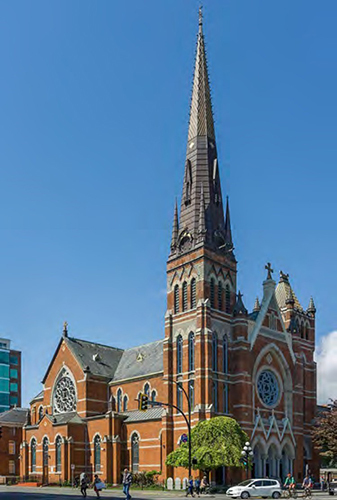
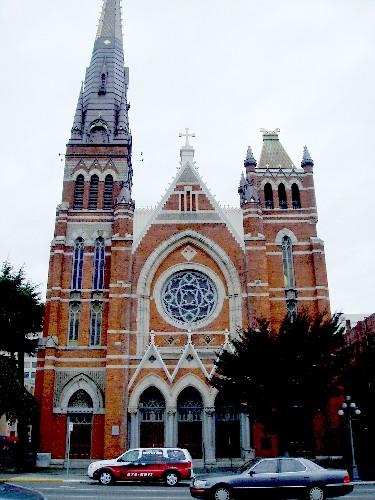
St. Andrew's Cathedral is a red brick High Victorian Gothic Revival Style church on the northwest corner of Blanshard and View Streets.
Heritage Value
St. Andrew's Cathedral is a valued surviving monument of the continuum of early Roman Catholic Church architecture in Victoria; it was constructed as the first major masonry structure for that denomination in the city. Constructed in 1892 - and still the largest church in Victoria in terms of floor space - this cathedral displays the confident spirituality that characterizes the best religious architecture of the time.
St. Andrew's Cathedral is valued as one of the few purely Gothic structures of its class on the West Coast. Inspired by European Cathedrals of the fourteenth and fifteenth centuries, the value of this church lies in its High Victorian Gothic Revival design by architects Perrault and Messiard of Montreal. Its key architectural elements include its emphatic verticality and picturesque asymmetry, marked in particular by its 175 foot tall spire. The value of its design lies in its brick and stonework, eclectic embellishments such as finials, crockets, latticework, and its one hundred stained glass windows. The interior of the church retains much of its original design, including the spatial configurations of the sanctuary with its arches, pillars, vaulted ceilings, and decorative traceries. Much of the church's original wooden furnishings, such as pews, remain alongside modern handmade liturgical furniture as reminders of the constant grandeur and grace of this historic house of worship.
Source: City of Victoria Planning and Development Department
Character-Defining Elements
The character-defining elements of St. Andrew's Cathedral include:
- exterior design elements relevant to its 1892 Perrault and Messiard design including: the 175 foot south tower and truncated north tower, copper cladding on tower roofs, decorative brick and stonework, and decorative elements such as latticework battens, crockets, finials, and trefoil and chevron embellishments;
- interior elements relevant to its original design, such as spatial configurations, finishes, and architectural elements;
- the 100 stained glass windows, including the prominent rose window;
- original furnishings, such as pews;
- liturgical furnishings commissioned in the 1980s from northwest coast aboriginal artists, such as the main altar and the ambo.
Gallery
1 imageLocation
Loading map...
Similar Places
Heritage sites with similar characteristics