Municipal Heritage Preservation Act
Robert Cruikshank Residence
Saint John, New Brunswick
Also known as Thomas Edward Grindon Armstrong Residence, Résidence Thomas Edward Grindon Armstrong
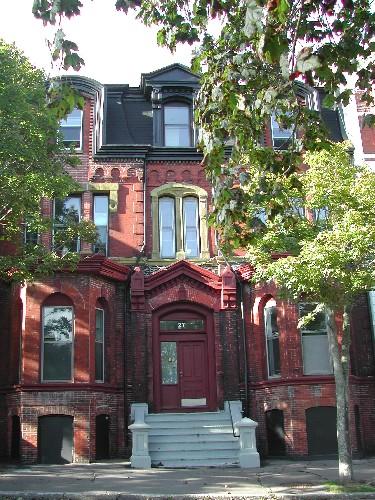
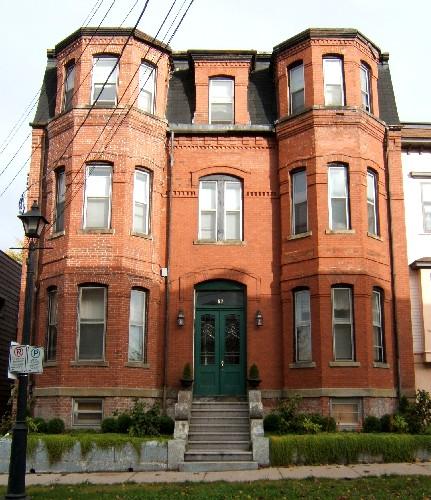
This photograph shows the contextual view of the building, 2005
Photo: City of Saint John
- Recognized
- 1982
- By
- Local government
The register’s text, word for word
Description
The Robert Cruikshank Residence is a brick two-and-a-half storey Second Empire building with a central entrance and two single-storey bay windows. It is located on Queen Square North in the Trinity Royal Heritage Preservation Area of Saint John.
Heritage value
The Robert Cruikshank Residence is designated a Local Historic Place for its architecture and for its association with the occupants.
The Robert Cruikshank Residence is recognized as one of a collection of residential and commercial Italianate and Second Empire buildings that were built between 1877 and 1881 after two thirds of the City of Saint John were destroyed by the fire in 1877. Built circa 1878, this residence is representative of the rebuilding period in Saint John following the fire. The use of brick sent a message that the city would be more fire resistant in the future and the elements and design in this building demonstrate that the city was going to be rebuilt as well or better than the city that was lost.
The Robert Cruikshank Residence is also recognized for its association with the original owner and occupant, Robert Cruikshank. He was from Forrest, Scotland and he studied law in Edinburgh. About 1844, he came to Saint John and entered the lumber firm of Adam and Davidson, where he remained until 1852. He then joined Jardine and Company, Saint John's leading wholesale grocer firm, on Prince William Street as a book-keeper. He later became a partner in Jardine and Company and remained with this firm until his retirement. After retirement, he engaged in the life insurance business as agent of the Star Company. He was greatly interested in the development of the Joggins Coal Mines and in promoting the Joggins Railway. He worked in many ways for the advancement of Saint John, such as gathering and compiling information for the Board of Trade's handbook on the Bay of Fundy and working feverishly in getting the harbour and river lighthouse service improved. Cruikshank passed away at the age of 72 in 1897.
The Robert Cruikshank Residence is also recognized through Thomas Edward Armstrong, who owned the home from 1905 until 1930. He was secretary of MRA Ltd. (Manchester-Robertson-Allison). MRA was Saint John's most popular furniture and household goods store for many years. He was also a lieutenant with the No. 4 Battery in Saint John.
The residence also reflects a housing trend resulting from the Great Depression. Many stately single family homes such as this were turned into multiple family dwellings in the 1930's and 1940's.
SourcePlanning and Development Department - City of Saint John
Character‑defining elements
The character defining elements that describe the Robert Cruikshank Residence include:
- similar set-back with neighbouring buildings;
- brick exterior walls;
- overall symmetry of the front façade;
- vertical sliding wooden windows;
- mansard roof;
- central pedimented dormer;
- segmented arch dormers with dentils along the window surround;
- dentils under the roof-line cornice;
- a brick motif of Roman arches in the spandrel panel between the roof-line cornice and the second storey windows;
- double-set elongated vertical windows in central bay in the second storey with sandstone surround, lintel and sill;
- two triple-set windows in the second storey in the end bays with sandstone lintels;
- single-storey bay windows on the ground storey with large cornices and contain three roman arch openings with keystones;
- sandstone stairway;
- entrance with a pitched entablature covering a segmented arch supported by Doric columns;
- brick quoins.
End of the register’s text
Location
27 Queen Square North , Saint John, New Brunswick, E2L, Canada
45.26978° N, 66.05637° W
Get directions (opens in a new tab)Being on the register doesn’t make a place open to visitors. Many are private homes or businesses; please view them from the street.

Loading map…
Similar places
Places whose register descriptions are closest to this one.
From the Canadian Register of Historic Places, as last updated on December 12, 2025. The register’s text is shown word for word.