National Historic Site of Canada
Ridout Street Complex National Historic Site of Canada
London, Ontario
Also known as Ridout Street Complex, Complexe de la rue Ridout
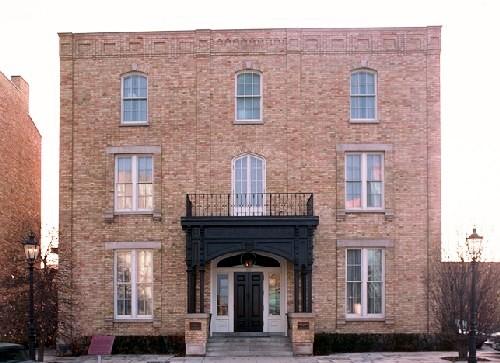
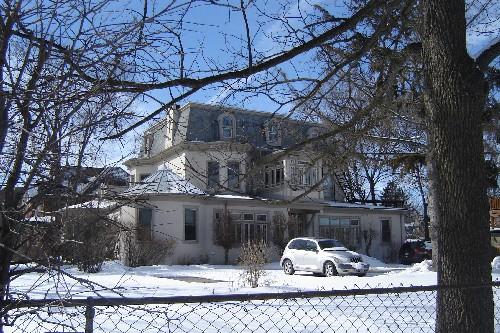
General view of the Ridout Street Complex, showing the Anderson Residence.
Photo: Parks Canada Agency / Agence Parcs Canada.
- Built
- 1838–1870
- Recognized
- 1966
- By
- Government of Canada
The register’s text, word for word
Description
The Ridout Street Complex National Historic Site of Canada, is located in downtown London, Ontario, at the confluence of the north and south branches of the River Thames. The complex is comprised of a row of three distinguished, mid-19th-century residential and commercial buildings, the Anderson Residence, the Bank of Upper Canada building and the Gore Bank of Canada building. Their forms, materials, and details provide unity to the group, while their individual treatments and separate structures provide a varied streetscape. The designation refers to the three buildings at 435, 441-447, and 451 Ridout Street North on their footprints as they existed at the time of designation (1966).
Heritage value
Ridout Street Complex was designated a national historic site of Canada in 1966 because:
- it provides a capsule view of the appearance of mid-19th century Ontario cities; and,
- it includes several of London’s earliest residential and commercial buildings.
The heritage value of this site resides in the grouping of these representative examples of mid-19th-century urban architecture in southwestern Ontario. Ridout Street North was London’s first financial district, where leaders in the fields of law, medicine, and finance established offices and homes. The street came to be known as ‘Banker’s Row’ after the establishment of the head offices of five banks, which were later turned into residences or business premises. The conservative classicized forms and the use of locally made buff-coloured brick are typical of the buildings in this area during the late 19th century.
SourceHistoric Sites and Monuments Board of Canada, Minutes, October 1966, June 2004.
Character‑defining elements
Key elements contributing to the heritage value of the site include:
- its location in downtown London, Ontario near the River Thames;
- the spatial relationship of the individual buildings, close to one another and to the street;
- the classically-inspired design evident in the refined proportions, rectangular massing, symmetry and restrained detailing of all three buildings;
- the brick and timber construction;
- the consistent exterior use of local buff-coloured brick;
- the symmetrically arranged façades with regular placement of multi-paned, double-hung windows;
- viewscapes on the complex as a whole from surrounding streets.
Key elements contributing to the heritage value of the Anderson Residence (No. 451) in the Ridout Complex include:
- its monumental rectangular three-storey massing under a flat roof with a slight pitch to the rear and four end chimneys;
- its Tudor-arched central doorway with sidelights, transom and paired double-hung windows framed by a brick surround, under a projecting portico;
- its range of segmental headed windows on the third floor exterior surmounted by a decorative brick frieze;
- any evidence of its original interior plan;
- any surviving original interior detailing, furnishing and fittings, including: shutters, door and window trim, ceiling mouldings, cornices, mantelpieces, fireplaces, columns and brackets.
Key elements contributing to the heritage value of the Gore Bank (Nos. 441-447) in the Ridout Complex include:
- its three-storey massing as one integral structure split along the line of a carriageway approximately one third of the distance from the south end;
- the semi-elliptical carriageway entrance and the double hung windows corresponding with the openings adjacent to the carriageway;
- the placement and integrity of the chimneys, set above the bold cornice;
- any surviving original interior features, including: mouldings, pilasters, panelled doors, balustrades, railings.
Key elements contributing to the heritage value of The Bank of Upper Canada (No. 435) in the Ridout Complex include:
- its two-storey rectangular massing under a low-pitched gable roof with two end chimneys, plainly detailed eaves and side façades forming parapets;
- its six-paneled central doorway with sidelights and an elaborate semi-elliptical fanlight;
- any surviving original interior features that are associated with the heritage value of the complex, including quirk trim and corner blocks, mantelpieces, staircases, and fireplaces.
End of the register’s text
Location
435, 441-447, and 451 Ridout Street North, London, Ontario, N6A, Canada
42.98419° N, 81.25495° W
Get directions (opens in a new tab)Being on the register doesn’t make a place open to visitors. Many are private homes or businesses; please view them from the street.

Loading map…
Nearby
All 11 places in London Eldon Housewithin 100 m · City of London · 1834
 Middlesex County Court House National Historic Site of Canada250 m · 1827
 Middlesex County Court House250 m · Ward 13 · 1827
 First Christian Reformed Church250 m · City of London · 1881
 Substation No. 4300 m · City of London · 1924
 Forks of the Thames Interpretive Centre300 m · City of · 1880
Similar places
Places whose register descriptions are closest to this one.
From the Canadian Register of Historic Places, as last updated on December 12, 2025. The register’s text is shown word for word.