Red Mountain Railway Bed
Description
This section of the railway is on the lands of the Okanagan, Sinixt, Secwepemc, Splats'in, Shuswap and Ktunaxa Nations. In 1896, Daniel C. Corbin of Spokane added a 30 kilometer (19 mile) extension to his Spokane Falls and Northern Railroad from Northport, Washington, to Rossland, British Columbia. Corbin bridged the Columbia River and built the Red Mountain Railway from Northport up to Rossland through the Little Sheep Creek Valley. The extension was called the Columbia and Red Mountain Railway in Washington State and the Red Mountain Railway on the Canadian side. It was a standard gauge line with an average grade of 2.75 percent and two spiral loops. There was a 'wye' for turning the trains on the Black Bear Mine flats (present day site of the Rossland Museum & Discovery Centre).
Heritage Value
The Red Mountain Railway bed is a testament to both the significant American involvement in the development of the mines of Rossland and the richness of the ore deposits. It also had significance as the major transportation route for both freight and passenger service between Spokane, Washington and Rossland, British Columbia
D.C. Corbin received large land grants totalling 510 acres within the City of Rossland from the provincial government in return for building an extension of his Spokane Falls and Northern Railroad from Northport, Washington, to Rossland, British Columbia. He completed his railway six months behind his competitor Fritz Heinze who had built the Columbia & Western Railway from Trail Creek Landing to the Rossland Camp.
The Red Mountain Railway Station was located on the flats between Third and Fourth Avenues between Washington and Spokane Streets.
The Red Mountain Railway carried some ore from American owned mines to smelters south of the border, but the majority of its business was freight and passengers between Spokane and Rossland. This changed in 1898 when the LeRoi Mining Company cancelled its contract with the Trail Smelter and began shipping to the new Le Roi Smelter which they had built across the U.S. border in Northport, Washington. When the British America Corporation purchased the Le Roi mine, later that year, they abandoned the Northport Smelter because of the law forbidding foreign ownership in the state of Washington. At this same time, July, 1898, the Great Northern Railroad took over all of Corbin's lines and Rossland became tied into the Great Northern system.
The history of the railways speaks to the competition for the delivery of the ore from the mines to the smelters. Competing smelters were located in Northport, Washington and Trail Creek Landing, British Columbia.
In 1900, for the convenience of business people, the Great Northern Railway inaugurated an overnight sleeping car service between Rossland and Spokane to supplement the existing day service. In 1921, with the ultimate closure of the Rossland mines in sight, Great Northern abandoned the line and in 1922 the rails between Rossland and Northport were removed. The bed today is not continuous as parts have been taken over by Highway 22 that connects Rossland with the Paterson border crossing leading to Northport, Washington.
Character-Defining Elements
The elements that define the heritage character of the Red Mountain Railway Bed include its:
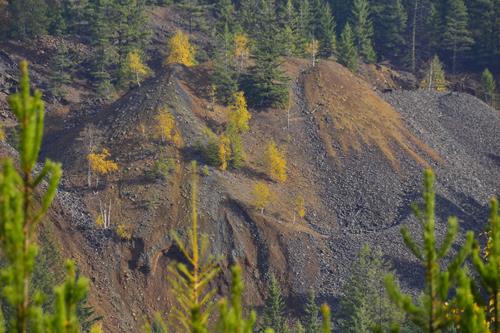
- ore dumps; and
- remaining railway beds.
Gallery
1 imageLocation
Loading map...
Similar Places
Heritage sites with similar characteristics