Columbia and Western Railway Bed
Description
This section of the Columbia and Western Railway is on the lands of the Okanagan, Sinixt, Secwepemc, Splats'in, Shuswap and Ktunaxa Nations.The Columbia & Western Railway was a 22 kilometer, 13 foot wide rail bed from Rossland, British Columbia to Trail Creek Landing using 3 foot (914 mm) narrow gauge rails. The elevation change from Trail to Rossland was 2300 feet (701 metres). This steep 4 - 4.8 percent grade required four switchbacks to get the train up the hill. In 1899, when the narrow gauge rail was replaced with standard gauge, two spiral loops were introduced into the switchbacks to reduce the grade. A 'wye' was added around Elmore Ave./Butte St. so the Columbia and Western trains could turn around. In railroad terminology, a wye is a triangular joining arrangement of three rail lines with a railroad switch at each corner connecting to each incoming line.
Heritage Value
The Columbia and Western Railway has historical significance for the community of Rossland and the development of its mines because it was one of the major transportation links between the rich ore deposits on Red Mountain and the smelter in Trail. Without the building of the railway, it is difficult to understand how challenging it would have been to bring equipment up the 13 kms to the mines and the ore down to the Columbia River.
In 1895, Fritz Augustus Heinze announced that he would be building a smelter in Trail and a railway to the Rossland mines to more easily transport the ore to the smelter.
Construction of the Columbia and Western Railway began in late 1895. The 22 kilometer railway was completed by June of 1896. In December of that year, the three times daily Rossland-Trail passenger service commenced.
In late 1896, a competing railway, the Red Mountain Railway was built by Daniel Corbin from Northport Washington to Red Mountain. The significance of these two railways is the urgency of getting the ore from Red Mountain to smelters, either in Trail or Butte Montana. The two railways were also a response to the Canadian versus American competition for the ore.
Upon completion of the line in 1896, the trains were the major carriers of freight and passengers up to Rossland from the connection at Trail Creek Landing with the steamers on the Columbia River from Revelstoke and Northport, Washington. The construction of this railway opened up access for passengers to travel beyond the local area for both goods and mining equipment. In addition, it contributed greatly to the increase in the population making it easier for new workers, prospectors and investors to reach the Red Mountain mines and what was to become Rossland. The completion of the rail lines made it possible to ship lower grade ores because competition between the two railways reduced rates.
The sale of the Columbia & Western Railay in 1898 for $600,000 to Canadian Pacific Railroad (CPR) underscored the economic importance of this area. In July 1899, CPR completed converting the route to 4 ft 8 1/2 in (1,435 mm) standard gauge. To gain 701 metres (2,300 ft) elevation in 22 kilometres, the line still included up to 4.8 per cent grades and tight curves.
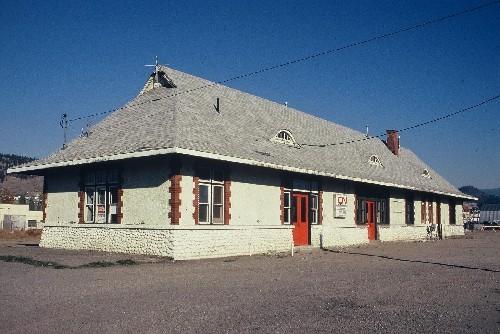
In Rossland, the CPR station was on the flats between Second and Third Avenues, between Washington and Queen Streets. The CPR yards included a rail yard, a two stall engine house, storage facilities, and a freight shed.
When the Le Roi mine closed in 1929, big ore trains ceased on the Rossland-Trail section. Highway improvements ended passenger service on this route in 1936. However, the three times a week freight train continued. In 1951, CP rebuilt the original station, but this replacement was demolished in 1973.
CPR abandoned its Rossland railway line in 1966 but today, the railway bed is still continuous from Rossland to Warfield and there is evidence of the area used for 2 of the switchbacks. The railway bed is used extensively by hikers, bikers and cross-country skiers.
Character-Defining Elements
The elements that define the character of the Columbia and Western Railway Bed include its:
- Original rail bed that exists from Union Street, between Spokane and Washington Streets, and Warfield; and
- Remaining Railway ties
Gallery
2 imagesLocation
Loading map...
Similar Places
Heritage sites with similar characteristics