Miners' Union Hall National Historic Site of Canada
Also known as: Miners' Union Hall National Historic Site of Canada, Miners' Union Hall, Miners' Union Hall
Description
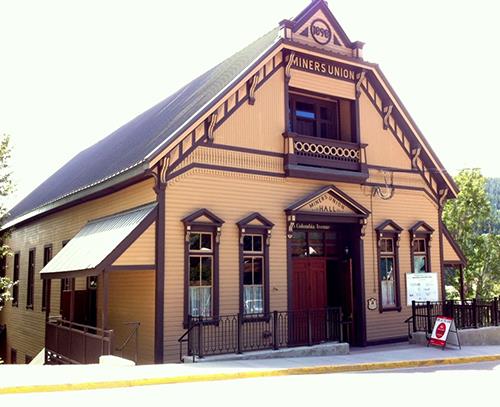
Miners’ Union Hall National Historic Site of Canada is a handsome timber building in the late-Victorian Gothic Revival Style prominently located in downtown Rossland, British Columbia. Located within a largely residential area, the building’s two-storey façade fronts Columbia Avenue while a steep treed escarpment enables three-storeys at the rear. The designation refers to the building on its footprint.
Heritage Value
The Miners’ Union Hall was designated a National Historic Site of Canada in 2019. It is recognized because:
• a rare surviving building of its type in Western Canada, this eclectic, wooden, late-Victorian Gothic Revival Style building serves as a major landmark for the community. Retaining excellent architectural integrity, it is still today an important community meeting place for the people of Rossland;
• it was constructed by Local 38 of the Western Federation of Miners (WFM) as a meeting place, and testifies to the union’s determined battle for miners’ rights in the region, which led to legislation guaranteeing an eight-hour work day for miners in the province (1899) and contributed to the enactment of the Conciliation Act (1900);
• built in 1898 in Rossland, a resource town marked by unprecedented economic growth following the late 19th century Gold Rush in Western Canada, it is a particularly rare and eloquent example in Canada of a building expressly designed to house a union hall.
Miners’ Union Hall was built to serve as a meeting place for Local 38 of the Western Federation of Miners. This local was founded in Rossland in 1895, and was the first union local in the mining sector in British Columbia. It led the fight for fair and safe working conditions which eventually produced legislation guaranteeing an eight-hour work day for miners in the province. This hall, a utilitarian structure, is also an eclectic example of the late-Victorian Gothic Revival style. A major landmark in Rossland, rehabilitation work preserved the main characteristics of its architecture, while its historical associations speak to this building’s historic connection with miners’ rights and miners in the region. Miners’ Union Hall also speaks to the importance of mining in Canada in late 19th century and early 20th century. Although it no longer serves as union hall, it is a well-used community gathering space.
Source: Historic Sites and Monuments Board of Canada, Minutes, June 2018.
Character-Defining Elements
Key elements contributing to the heritage value of this site include:
- its prominent location on a main street in downtown Rossland in a largely residential setting;
- its rectangular footprint, distinct massing, two-storey front elevation and three-storey rear elevation with steeply pitched gable roof;
- the late-Victorian Gothic Revival Style decoration including that on the pediment at the top of the façade, the decorative roof parapet and gable;
- the symmetrical façade’s classical architecture elements, including triangular pediments above windows and doors, inset central balcony, carved wooden ornamentation, and the original inscriptions “1898” on the central gable, “Miners Union” on the balcony, and “Miners Union Hall” over the central door;
- the large central entrance with glazed transom flanked by tall rectangular windows, the regularly placed windows on the side elevations, and balcony and shed-roofed side entrances;
- the boom town influenced construction using wooden posts and beams, wood siding and details;
- the original plan and distribution of interior spaces including the lobby, open auditorium with cathedral ceiling, inclined wooden stage, basement and attic;
- surviving original materials, wood finishes executed in fir and cedar including doors, wall panelling, exposed wooden beams, embossed metal ceilings and metal ventilation grilles.
Gallery
1 imageLocation
Loading map...
Similar Places
Heritage sites with similar characteristics