Recognized Federal Heritage Building
Lone Shieling
Cape Breton Highlands National Park of Canada, Nova Scotia
Also known as Lone Shieling Shelter, Refuge Lone Shieling
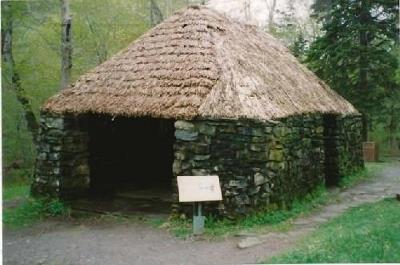
Front elevation of the Lone Shieling, showing its simple, low massing composed of a rectangular structure with low, heavy walls and a steeply pitched hipped roof, 1993.
Photo: Parks Canada Agency / Agence Parcs Canada, 1993.
- Built
- 1942
- Recognized
- 1994
- By
- Government of Canada
The register’s text, word for word
Description
The Lone Shieling, located on a roughly landscaped site at Cape Breton Highlands National Park, is a rectangular structure closely modeled after Scottish traditional dwellings for crofters or tenant farmers. It features low, massive, random rubblestone walls, rough-hewn timbers and a thatched roof. The designation is confined to the footprint of the building.
Heritage value
The Lone Shieling is a Recognized Federal Heritage Building because of its historical associations, and its architectural and environmental value.
Historical Value
The Lone Shieling at Cape Breton Highlands National Park is one of the first national parks in the Maritime Provinces and is associated with the expansion of the parks system to eastern Canada. It is also strongly associated with a Scottish theme, which was adopted by the National Parks Bureau in order to highlight Cape Breton’s physical resemblance to the Scottish Highlands. One of the earliest structures in the park, it illustrates the traditional heritage of the local inhabitants from the crofter class of the Scottish Highlanders.
Architectural Value
The Lone Shieling is a very good example of a basic shelter known as a ‘bothran’, a seasonal dwelling traditionally used by shepherds in Scotland during the time of year when sheep were moved to graze on the highlands, away from the village. Designed to promote the traditional heritage of the crofter class of the Scottish Highlanders, the Lone Shieling is characterized by its simple form and massing which is based on the rustic image of a ‘bothran’. It is also valued for its quality stonework detailing, and timber and thatch roofing. Professor S. Macintosh, who bequeathed the 100 acres of land for the park, requested that a small cabin be built in the same design as the Lone Shieling on the Isle of Skye in Scotland.
Environmental Value
The Lone Shieling, one of the earliest structures in the park, maintains an unchanged relationship to its site and is compatible with its highland park setting. Situated close to the Cabot Trail it is a well-known landmark in the area.
SourceKatherine Spencer-Ross, Lone Shieling Shelter, Cape Breton Highlands National Park Cape Breton, Nova Scotia, Federal Heritage Building Review Office Building Report 93-071; Lone Shieling Shelter, Cape Breton Highlands National Park, Cape Breton, Nova Scotia, Heritage Character Statement, 93-071.
Character‑defining elements
The character-defining elements of the Lone Shieling should be respected.
Its basic shelter ‘bothran’ design, craftsmanship and materials, for example:
— its simple, low massing composed of a rectangular structure with low, heavy walls and a steeply pitched hipped roof;
— its rustic character as demonstrated by the irregular pattern fieldstone walls, wood frame construction and thatch roof with roofing frames of purlins and rafters;
— the simple, symmetrically arranged unadorned window and door openings;
— the simple interior rectangular plan divided into two sections by log partitions.
The manner in which the Lone Shieling maintains an unchanged relationship to its site, is compatible with the character of its Highland Park setting and is a well-known landmark in the area, as evidenced by:
— its ongoing relationship to its roughly landscaped site on a sloped clearing and to the adjacent retaining wall and commemorative cairn;
— its basic shelter ‘bothran’ design and natural construction materials which harmonizes with its setting on the edge of an old growth Acadian forest in Cape Breton Highlands National Park;
— its proximity to the Cabot Trail and visible location along the Lone Shieling Nature Trail, which is highly frequented by travellers to the area.
End of the register’s text
Location
Cape Breton Highlands National Park of Canada, Nova Scotia, Canada
46.73032° N, 60.51524° W
Get directions (opens in a new tab)Being on the register doesn’t make a place open to visitors. Many are private homes or businesses; please view them from the street.

Loading map…
Nearby
 Information Bureau12 km · Cape Breton Highlands National Park of Canada / Parc national du Canada des Hautes-Terres-du-Cap-Breton · 1939
 Administration Building13 km · Cape Breton Highlands National Park of Canada / Parc national du Canada des Hautes-Terres-du-Cap-Breton · 1938
 Superintendent's Residence13 km · Cape Breton · 1938
 Neil's Harbour Lighthouse17 km · Victoria County · 1899
 Coastal Lighthouse17 km · Neils Harbour · 1899
 St. Paul Island Southwest Lighthouse19 km · Dingwall · 1915
Similar places
Places whose register descriptions are closest to this one.
 ShelterSt. Lawrence Islands National Park of Canada / parc national du Canada des-Îles-du-Saint-Laurent, Ontario
 Sandhills Wardens CabinBanff National Park of Canada/ Parc national du Canada Banff, Alberta
 Picnic Shelter / LodgeAulac, New Brunswick
 Wardens CabinBanff National Park of Canada, Alberta
 Little Heaven Warden Patrol CabinJasper National Park of Canada / Parcs national du Canada Jasper, Alberta
 Museum and Caretaker's HouseLouisbourg, Nova Scotia
From the Canadian Register of Historic Places, as last updated on December 12, 2025. The register’s text is shown word for word.