Hartland Covered Bridge
Description
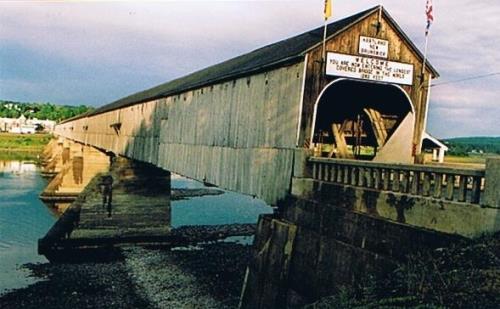
The Hartland Covered Bridge Provincial Historic Site consists of a seven span Howe truss structure, 391m long, crossing the St. John River at Hartland.
Heritage Value
The Hartland Covered Bridge is the longest covered bridge in the world and one of the most recognized structures in Canada. It is significant both for its structural qualities, contributions to transportation, and as a symbol of the heritage of covered bridges in New Brunswick.
After the destruction of two spans of the original 1901 structure during an ice jam in 1920, the bridge was completely rebuilt and covered by 1922. The present bridge is a standard covered bridge structure composed of a Howe truss superstructure enclosed with vertical unpainted weatherboard siding and shingle roof. It is typical of New Brunswick covered bridges in its details of construction and lack of ornamentation
An interior electric light system was first installed in 1924, making it one of the few illuminated covered bridges. The covered pedestrian sidewalk on the downriver side was added in 1945.
Source: New Brunswick Culture and Sport Secretariat, Heritage Branch, Site File # 88.
Character-Defining Elements
- its original location spanning the Saint John River;
- the bridge’s length at 391 m, making it the longest covered in the world;
- the heavy-timber Howe truss structure, typical of covered bridge construction and engineering of this period in New Brunswick;
- the concrete piers supporting the trusses, with their tapered shape on the upriver side to break ice flows;
- the shingled gable roof typical of New Brunswick covered bridges
The material elements of the bridge, typical of the majority of New Brunswick’s covered bridges, include:
- virtually no roof overhangs on the gable ends and roof eaves;
- lack of ornamentation;
- the vertical unpainted weatherboard siding material;
- the plain ends with their arched portals finished with weathered boards and thin white painted trim boards;
- the outer board sheathing on the upriver side that has a row of small openings allowing light and air, roofed with small projections to keep out snow and rain;
- the covered pedestrian sidewalk on the downriver side;
- illumination by an interior electric light system.
Gallery
3 imagesLocation
Loading map...
Similar Places
Heritage sites with similar characteristics