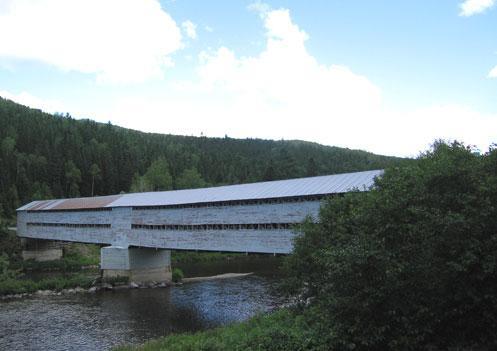
Powerscourt Covered Bridge National Historic Site of Canada
Also known as: Powerscourt Covered Bridge National Historic Site of Canada, Powerscourt Covered Bridge, Pont couvert de Powerscourt
Description
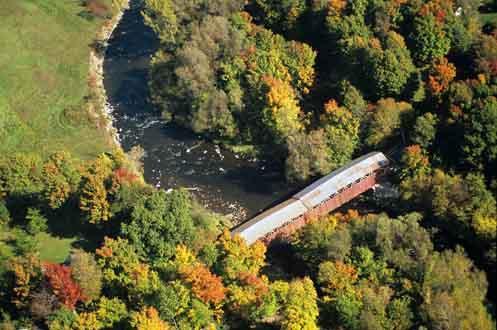
Powerscourt Covered Bridge National Historic Site of Canada is a long wooden covered bridge that still stands on its original stone foundations in Elgin Township, Huntingdon County, Québec, where it carries traffic on the First Concession Road over the Châteauguay River. Featuring three freestanding regularly coursed masonry piers, an irregular roofline and two functionally independent truss spans, it is noted as the only remaining McCallum inflexible arched truss bridge in the world. Official recognition refers to the bridge on its footprint.
Heritage Value
The Powerscourt Covered Bridge was designated a national historic site of Canada in 1984 because:
- it is the only known example of a McCallum inflexible arched truss bridge still in existence;
- it is one of the oldest covered bridges that exists in Canada.
The heritage value of Powerscourt Covered Bridge lies in its age and in its use of the rigid (or inflexible) arch truss construction technology. This technology, more commonly used for railway construction, was invented by New York bridge builder Daniel McCallum in 1851. Also known locally as Percy Bridge, it was built in 1861 to carry traffic on the First Concession Road over the Châteauguay River.
Source: Historic Sites and Monuments Board of Canada, Minutes, June 1984.
Character-Defining Elements
Key elements contributing to the heritage value of the bridge include:
- the location and setting on the Châteauguay River;
- the linear footprint, rectangular massing and curved roof line;
- the physical and design integrity of the components that together create the McCallum rigid arched trusses;
- the use of vertical wooden board and batten weatherboard siding;
- the presence of an opening between the roof and side covering;
- the integrity of the form, materials and craftsmanship of the stone masonry substructure, with the solid wall construction of the three freestanding piers;
- viewscapes from the bridge to the roadbed connecting with it at each end.
Gallery
1 imageLocation
Loading map...
Similar Places
Heritage sites with similar characteristics