Provincially Registered Property
Gilbert H. Grosvenor Hall
Baddeck, Nova Scotia
Also known as Bras d'Or Lakes and Watershed Interpretive Centre, Old Baddeck Post Office
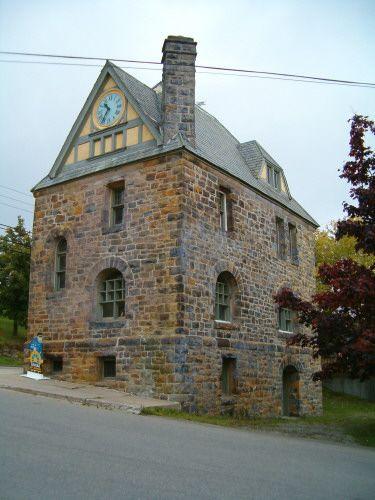
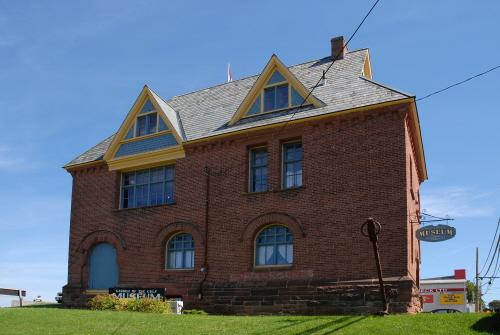
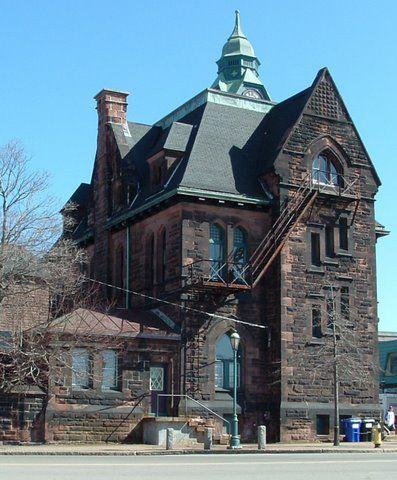
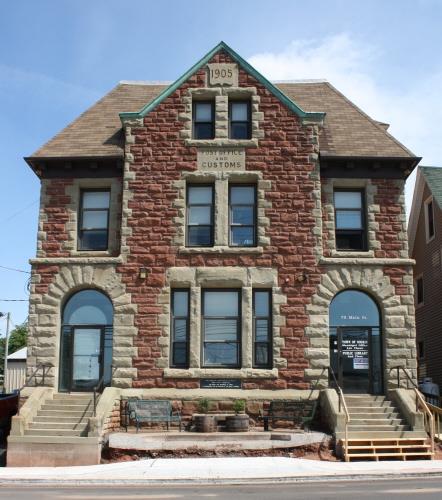
Gilbert H. Grosvenor Hall side and rear elevation.
Photo: Heritage Division, NS Dept. of Tourism, Culture and Heritage, 2004.
- Built
- 1885–1886
- Recognized
- 1983
- By
- Province of Nova Scotia
The register’s text, word for word
Description
Gilbert H. Grosvenor Hall is located on one of the main streets in the Village of Baddeck, Victoria County. This former Post Office and Custom House was opened in 1886. The three-storey, red sandstone building is an early example of a general design with Romanesque Revival elements, typical of a number of public buildings erected by the federal government in the nineteenth century. The building and surrounding property are located in the provincial designation.
Heritage value
Gilbert H. Grosvenor Hall is valued for its architectural style, with elements typical of a Canadian post office built in the nineteenth century.
Gilbert H. Grosvenor Hall was originally the Baddeck Post Office and Custom House. This three-storey, stone building was constructed between 1885 and 1886 and was officially opened by the Federal Government on October 30, 1886. The Post Office was located on the main floor and the Customs House on the second floor. It was built with stone that was barged in from nearby Boularderie and was in operation until the Federal Government closed it in 1956 and moved the Post Office to new, smaller quarters.
It was then purchased a few years later by Mr. S.A. Gayley who gave it to his wife, granddaughter of Alexander Graham Bell, as a gift. Mrs. Gayley named the building the Gilbert H. Grosvenor Hall, in memory of her father, Gilbert H. Grosvenor, who was editor of the National Geographic Magazine from 1903 to 1954. She presented the building to the Baddeck Library Board as a memorial to her father's work and Grosvenor Hall housed the Baddeck Public Library until the 1980s. It now houses the Bras d'Or Lakes and Watershed Interpretive Centre.
The Post Office was designed by Thomas Fuller, Chief Architect of Canada and co-designer of Ottawa's first Parliament buildings. Styled in the Romanesque Revival tradition, this is a three-storey, red sandstone building with heavy stone work and rounded arches over the doors and windows which add to the fortress-like appearance of the design. It is one of the village's most important landmarks. The clock, located on the west gable, was donated to the village in 1912.
The face, carved in stone above the main entrance, is that of Charles J. Campbell, Conservative Member of Parliament for Victoria County. It was carved the same year the Post Office opened.
SourceProvincial Heritage Property files, no. 23, Heritage Division, 1747 Summer Street, Halifax, NS
Character‑defining elements
Character-defining elements of Gilbert H. Grosvenor Hall, with Romanesque Revival elements, include:
- central location in the Village of Baddeck;
- heavy stone work with rounded arches over doors and windows;
- copper and slate high hipped roof;
- decorative features include carvings, voussoirs, sills, dormers and gables;
- post office clock in the west gable;
- face carved in stone above the main entrance;
- red sandstone construction.
- one stone chimney located on the east side;
- one offset stone chimney located on the south-west corner.
End of the register’s text
Location
532 Chebucto Street, Baddeck, Nova Scotia, B0E, Canada
46.10087° N, 60.74814° W
Get directions (opens in a new tab)Being on the register doesn’t make a place open to visitors. Many are private homes or businesses; please view them from the street.

Loading map…
Nearby
All 7 places in Baddeck Victoria County Court House250 m · 1889
 St. Mark's Masonic Lodge350 m · 1898
 Alexander Graham Bell National Historic Site of Canada600 m · 1954
 Alexander Graham Bell Museum600 m · 1954
 Saint Peter's and Saint John's Anglican Church700 m · 1883
 Beinn Bhreagh Hall National Historic Site of Canada2.6 km · Baddeck Bay · 1892
Similar places
Places whose register descriptions are closest to this one.
From the Canadian Register of Historic Places, as last updated on December 12, 2025. The register’s text is shown word for word.