Heritage Railway Station
Former Canadian National Railway Station
Fort Frances, Ontario
Also known as Canadian Northern Railway Station
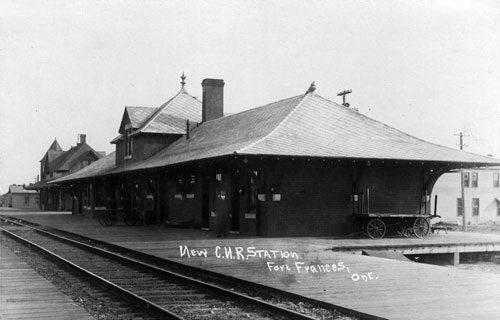
Not from the Register. Photo: Wikimedia Commons · Public domain
- Built
- 1913
- Recognized
- 1994
- By
- Government of Canada
The register’s text, word for word
Description
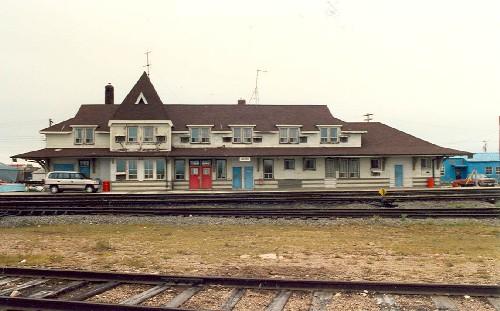
The former Canadian National Railway (CNR) station at Fort Frances, which was originally part of the Canadian Northern Railway (CNoR) system, was built in 1913. It is a relatively large 1 ½ storey station with a distinctive profile featuring a capped tower and steeply pitched gabled roofline. Today it serves as a local museum.
Heritage value
The station at Fort Frances has been designated a heritage railway station because of its historical associations, and also for its architectural and environmental significance.
The former Canadian National Railway (CNR) station at Fort Frances, which was originally part of the Canadian Northern Railway (CNoR) system, was built in 1913. It was designed by the CNoR Engineering Department in Winnipeg, and still retains a form recognizable in early 20th century prairie and western railway stations. Once the CNoR was built, Fort Frances took advantage of its strategic location as one of the railway links between the United States and Canada to develop the community as a milling centre for raw lumber material from both sides of the border. Over the years, this station has accommodated traditional railway services for passengers and freight, as well as customs and immigration services. A sympathetic 1928 extension to the east end provided additional space for the express room and an office.
The heritage value of the former CNoR station at Fort Frances resides the extent of its integrity and the railroad history to which it bears witness. It lies in the legibility of the station’s design, simple massing, traditional materials, and modest architectural detail.
Source:
Heritage Character Statement, Canadian Northern Railway Station, Fort Frances Ontario, October 1993. Heritage Assessment Report RSR-170, 1993.
Character‑defining elements
Character-defining elements of the Former Canadian National Railway Station include:
- the elongated footprint due to the 1928 east end baggage addition, its 1½ storey massing, and low-pitched hipped roof with projecting bell-cast eaves and dominant off-centre square second storey capped pyramidal roof cut by gable dormers, a conically-capped tower, and projecting chimneys,
- its defining profile, dominated by complex, many layered roof forms from all four angles,
- its substantial proportions,
- the station’s dual function as a public railway facility and residence,
- the balance inherent in its vertical definition,
- the asymmetrical yet rhythmic placement of its apertures and eave brackets,
- the picturesque inspiration of its details: irregular roof forms, segmentally-arched aperture heads, multi-paned windows, prominent brackets, broad bell-cast eaves, gabled dormers, octagonal tower,
- the varying colours and textures of its original materials: red brick walls on a concrete foundation, cut stone lug sills, wooden doors and trim,
- the station’s platform frame construction technology,
- any and all original fabric inside the station,
- any and all surviving indications of the station’s original functional and spatial configuration.
End of the register’s text
Location
140, 4th St. W. (west of Central Ave.), Fort Frances, Ontario, P9A, Canada
48.61350° N, 93.40300° W
Get directions (opens in a new tab)Being on the register doesn’t make a place open to visitors. Many are private homes or businesses; please view them from the street.

Loading map…
Similar places
Places whose register descriptions are closest to this one.
 Canadian National Railway StationOrillia, Ontario
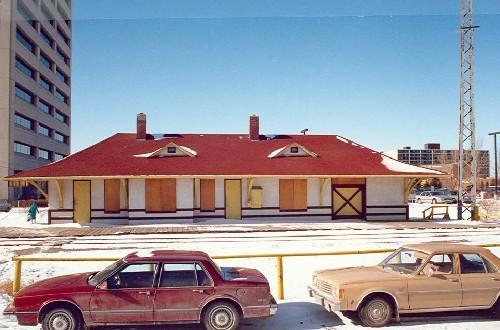 Former Canadian Northern Railway StationWinnipeg, Manitoba
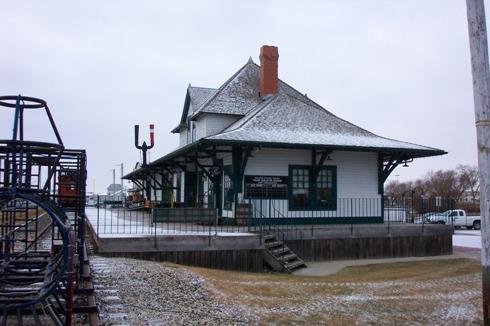 Canadian Northern Railway StationFort Saskatchewan, Alberta
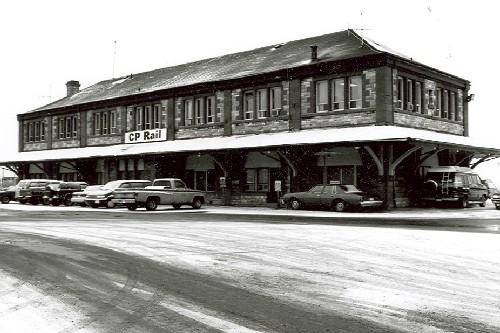 Canadian Pacific Railway StationNorth Bay, Ontario
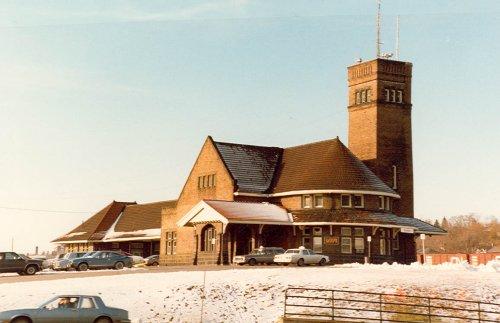 Canadian National Railways StationBrantford, Ontario
 VIA Rail - Canadian National Railway StationChurchill, Manitoba
From the Canadian Register of Historic Places, as last updated on December 12, 2025. The register’s text is shown word for word.