National Historic Site of Canada
Ermatinger House National Historic Site of Canada
Sault Ste. Marie, Ontario
Also known as Ermatinger House, Maison Ermatinger, Old Stone House
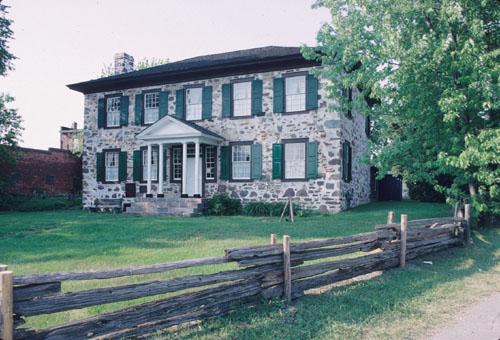
Corner view of the Ermatinger House, showing the façade and a side, 1995.
Photo: Parks Canada Agency/ Agence Parcs Canada, 1995.
- Built
- 1812–1823
- Recognized
- 1957
- By
- Government of Canada
The register’s text, word for word
Description
The Ermatinger House National Historic Site of Canada is located in Sault Ste. Marie, Ontario. Built between 1814 and 1823 by Charles Ermatinger of the North West Company, is believed to be the oldest surviving house in northwestern Ontario. It is an classically inspired, two-storey, five bay house with a hip roof, built of stout masonry and heavy timber framing. Official recognition refers to the building on its legal lot.
Heritage value
The Ermatinger House was designated a national historic site of Canada in 1957 because:
- its builder, Charles Oakes Ermatinger, was an active partner of the North West Company;
- it was the headquarters of Sir Garnet Wolseley in 1870 when stopping at the Soo on route to Red River;
- it became the centre of the business and social life of the whole district.
Constructed when Sault Ste. Marie was still a small fur trading post on the Upper Lakes, this fine house soon became the centre of the districts business and social life, and was noted by such visitors as Lord Selkirk, Anna Jameson, Sir John Richardson, Paul Kane and George Catlin. It was built between 1812 and 1823 by Charles Ermatinger, an independent fur trader with business and family connection in Montreal. Ermatinger in 1812 had led a party of volunteers under Captain Roberts in the capture of Michilimackinac which secured the North Country for the British and was a powerful factor in bringing about the surrender, by Hull, of Detroit in August, 1812. The Ermatinger family left Sault Ste. Marie in 1828.
The imposing house was large for its time (35 feet by 40 feet) and, with its masonry construction and classically inspired design, was an outstanding landmark in its day. A succession of occupants used the house as a mission, hotel, tavern, courthouse, post office, dance hall, tea room and apartment building. In 1965 the building was purchased by the City of Sault Ste. Marie and restored to its original appearance. It is now a House Museum.
SourceHistoric Sites and Monuments Board of Canada, Minutes, June, 1957.
Character‑defining elements
The key elements that contribute to the heritage character of this site include:
- the prominent location on the St. Mary’s River;
- the symmetrical, two-storey, five bay massing under a hipped roof;
- the sturdy construction of stone set in lime mortar with heavy timber framing;
- the classical composition of its facade;
- the existence of a formal, pillared entry porch;
- surviving original materials both exterior and interior;
- evidence of the original domestic functional plan.
End of the register’s text
Location
831 Queen Street East, Sault Ste. Marie, Ontario, P6A, Canada
46.50640° N, 84.32390° W
Get directions (opens in a new tab)Being on the register doesn’t make a place open to visitors. Many are private homes or businesses; please view them from the street.

Loading map…


Similar places
Places whose register descriptions are closest to this one.
 Park House National Historic Site of CanadaAmherstburg, Ontario
 Superintendent's HouseSault Ste. Marie, Ontario
 Fort Erie National Historic Site of CanadaFort Erie, Ontario
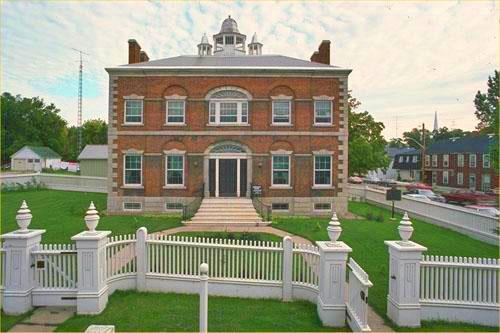 McMartin House National Historic Site of CanadaPerth, Ontario
 Fort Sainte Marie II National Historic Site of CanadaChristian Island, Ontario
 LeBer-LeMoyne House National Historic Site of CanadaLachine, Quebec
From the Canadian Register of Historic Places, as last updated on December 12, 2025. The register’s text is shown word for word.