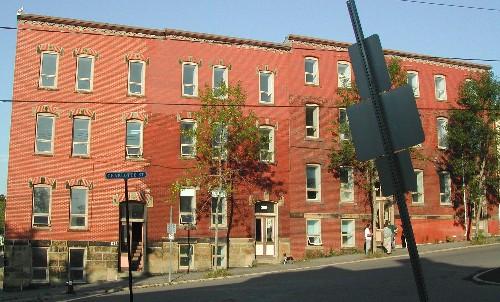
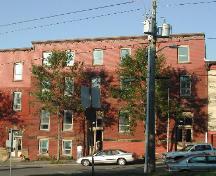
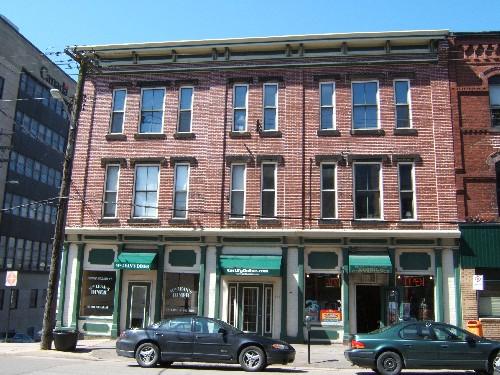
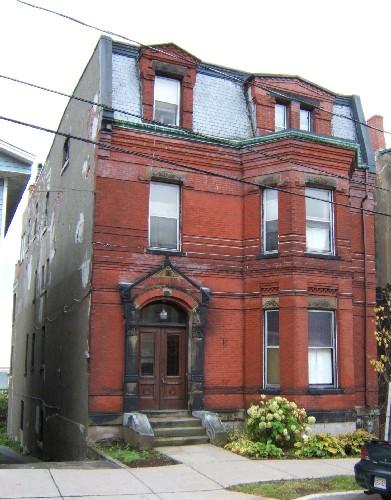
This photograph is a contextual view of the building on Charlotte Street. This residence is the unit on the left side of the image. 2005.
Photo: City of Saint John
- Built
- 1879
- Recognized
- 1982
- By
- Local government
The register’s text, word for word
Description
The Daniel J. McLaughlin Residence is one of four adjacent three-storey brick buildings of similar Italianate architecture, with segmented arch window openings and decorative stonework at the cornice. It is located on Charlotte Street, within the Trinity Royal Preservation Area of the City of Saint John.
Heritage value
The Daniel J. McLaughlin Residence is designated a Local Historic Place for its architecture and for its association with its past owners and occupants.
The Daniel J. McLaughlin Residence is one of a collection of residential Italianate buildings that were built after two thirds of the City of Saint John was destroyed by fire in 1877. Built in 1879 for Henry Maxwell, the Daniel J. McLaughlin Residence is a good example of Italianate residential architecture from the rebuilding period in Saint John. This style is evident in details such as the decorative cornice, the arched window openings and the rectangular massing. The use of brick and the quality of the workmanship in this residence represent the will for the city to rebuild, as well or better, after the fire.
Daniel J. McLaughlin Residence is also recognized for the past owners and occupants that have been associated with this residence. Henry Maxwell had this home constructed in 1879, in addition to the three adjacent dwellings. Arriving in Saint John in 1834, Maxwell established his own lumber business in 1850. Once his son, Charles H. Maxwell, joined him in the business in 1869, the firm name officially became “Henry Maxwell & Son”. By 1887, Henry had become one of the oldest established lumber dealers of the City whose firm maintained a highly successful trade throughout the Maritimes.
While residing in a neighbouring building located at 265 Charlotte Street, Maxwell rented out this residence to some very significant individuals. The first resident was William Black. Both a ship chandler and grocer, he operated his business on Water Street for several years. After a brief residency, he left in 1882 to move to Rothesay.
Prominent businessman, Daniel J. McLaughlin came to this residence soon after. A highly influential citizen of Saint John, McLaughlin heavily involved himself in politics and several businesses. As well as being a flour merchant, a lumber dealer and a ship owner, he acted as president of the Saint John Gas Company, the Suspension Bridge Company and the Commercial Bank. Throughout the 1850’s and 60’s, he strongly opposed Confederation. Notably, McLaughlin was also responsible for the construction of the large society hall and business center on Germain Street known as the McLaughlin Building. He remained at this residence until the late 1890’s.
SourcePlanning and Development Department - City of Saint John
Character‑defining elements
The character defining elements that describe the Italianate architecture of the Daniel J. McLaughlin Residence include:
- rectangular three-storey massing with an elevated basement that follows the slope of Charlotte Street;
- exterior brick walls;
- decorative stonework at the cornice;
- segmented arched window openings with sandstone sills;
- brick hood moulds with corbel stops over rectangular windows;
- two paned segmented arched transom window above the entrance with highly ornate surrounds consisting of a medallion and delicate floral designs;
- paired wooden doors with glass panels;
- sandstone plinth band;
- sandstone steps.
End of the register’s text
Location
271 Charlotte Street, Saint John, New Brunswick, E2L, Canada
45.26835° N, 66.05736° W
Get directions (opens in a new tab)Being on the register doesn’t make a place open to visitors. Many are private homes or businesses; please view them from the street.

Loading map…
Similar places
Places whose register descriptions are closest to this one.
From the Canadian Register of Historic Places, as last updated on December 12, 2025. The register’s text is shown word for word.