Municipal Heritage Preservation Act
Caverhill Hall
Saint John, New Brunswick
Also known as Simeon Jones Residence, Résidence Simeon Jones
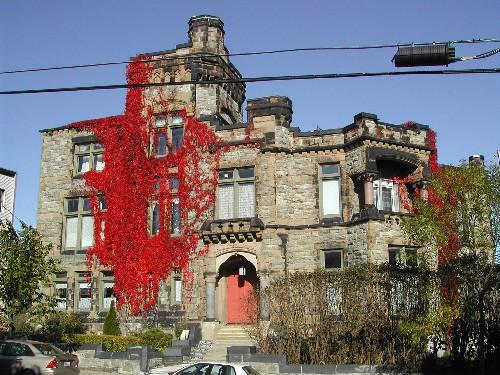
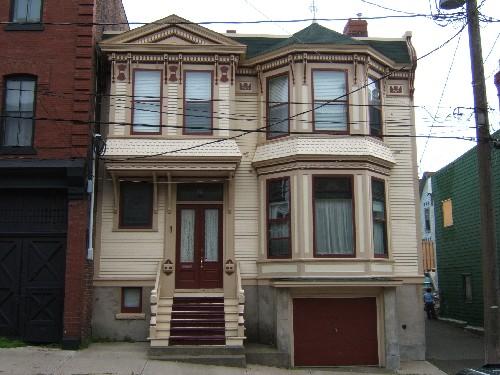
This photograph shows the Sydney Street façade, 2005
Photo: City of Saint John
- Built
- 1884
- Recognized
- 1982
- By
- Local government
The register’s text, word for word
Description
Caverhill Hall is a two-storey limestone Baronial Gothic castle-like mansion with balustrades and a tower. It is located on Sydney Street in Saint John.
Heritage value
Caverhill Hall is designated a Local Historic Place for its architecture and for its association with its former the occupants.
Caverhill Hall is recognized for its unique architectural style. This building ranks near the forefront of all residences in the Province of New Brunswick. This home was built in 1884, seven years after the Great Saint John Fire of 1877, for Simeon Jones. It is a two-storey limestone Baronial Gothic castle-like mansion with balustrades and towers. It represents one of the uniquely elaborate styles of residential architecture indulged in by more wealthy citizens of the Victorian Era. The design of the home was inspired by a house Jones and his wife had admired in Toronto. For many years, it was described as the finest residence in New Brunswick and possibly the finest in the Maritime Provinces. The exterior of this limestone building displays broad windows, pillared balconies, battlement tower, and a commanding entrance. The interior has a winding staircase, parlour, music room, libraries, an octagonal hall, and paintings embedded into the walls.
Caverhill Hall is also recognized for its association with the Jones family. Simeon Jones was a former mayor of Saint John and a brewer. His brewery employed 12 people and the products of his brewery consisted of high class ales. In 1879, he was elected a member of the city council, and in 1881 he was chosen mayor of Saint John by acclamation, the first to do so. He was mayor until 1884, the year this home was constructed. The home was later transferred to his son, Robert Keltie Jones. This building was named Caverhill Hall after the maiden name of Simeon Jones’ mother.
Caverhill Hall is also recognized for having hosted royalty. In 1901, Robert Keltie Jones placed his house at the disposal of the local government to house the Duke and Duchess of Cornwall and York and the Prince of Wales. The Prince of Wales later became King George V. About 1914, the Jones' ceased their residency and the brewery was sold to G. W. Oland, of Halifax in 1918.
Caverhill Hall is also recognized for its association with the war effort during the two World Wars and for its association with health care. Military officers used this residence as a headquarters during the First World War. It was sold to the municipality about 1923 to be used as a health centre. It became the St. John Health Centre, and remained as such until the Second World War. Caverhill Hall then became a recreation centre for the Royal Canadian Air Force and was the Royal Canadian Air Force Social Club for over 20 years.
SourcePlanning and Development Department - City of Saint John.
Character‑defining elements
The character defining elements that describe Caverhill Hall include:
- asymmetrical two-storey massing;
- limestone construction;
- rectangular vertical sliding wood windows in single, double and triple sets;
- quatrefoil designs at the bases of the balustrades;
- roof over the balustrade supported by red granite columns with Corinthian capitals;
- battlement tower;
- stone brackets under cornices;
- entrance ornamented by two large grey granite columns;
- wide recessed entranceway;
- paired wooden paneled doors;
- hanging vines;
- sandstone steps.
The interior elements that describe Caverhill Hall include:
- spatial configuartion;
- Victorian-era paintings embedded in the walls;
- cherry wood doors;
- octagonal hall;
- winding staircase.
End of the register’s text
Location
134-136 Sydney Street, Saint John, New Brunswick, E2L, Canada
45.27027° N, 66.05579° W
Get directions (opens in a new tab)Being on the register doesn’t make a place open to visitors. Many are private homes or businesses; please view them from the street.

Loading map…
Similar places
Places whose register descriptions are closest to this one.
From the Canadian Register of Historic Places, as last updated on December 12, 2025. The register’s text is shown word for word.