Carleton County Gaol
Also known as: Ottawa International Hostel, Carleton County Gaol
Description
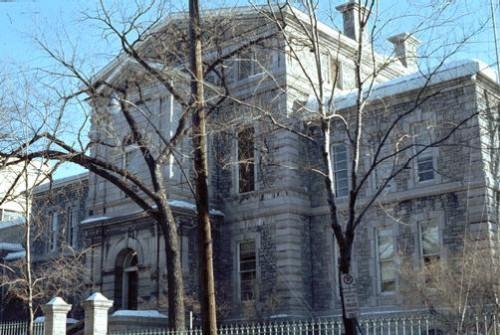
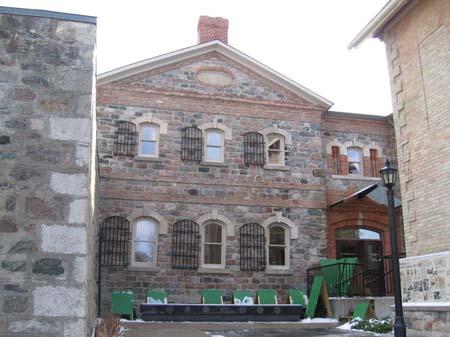
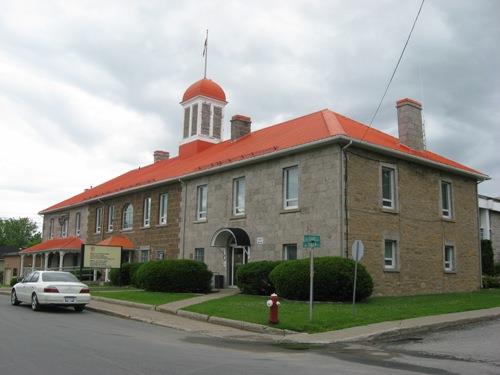
The Carleton County Gaol is located at 75-77 Nicholas Street, in between Wilbrod Road and Laurier Avenue East and consists of a three-and-a-half-storey stone structure in the Italianate style. The Carleton County Gaol was the first jail house to be built in the Ottawa area and was to serve the then new District of Dalhousie, later Carleton County. The building was completed in 1862 in conjunction with an adjacent courthouse and was designed by Henry Horsey. The Carleton County Gaol is currently used as a youth hostel.
The Carleton County Gaol is recognized by the City of Ottawa for its historical, architectural, and contextual value in By-law 380-78.
Heritage Value
The contextual significance of the Carleton County Gaol lies in its proximity to surrounding structures such as the Carleton County Courthouse.
The Carleton County Gaol is recognized for its historical value as one of the area's earliest prisons. The Carleton County Gaol opened in 1862 and served as a prison until its closure in 1972, after which the Canadian Youth Hostel purchased the building and began operating it as a youth hostel. The Carleton County Gaol tells the story of Ottawa's earliest prison inmates and incarceration system. The prison housed a wide range of inmates, from those who had committed minimal offences to murderers. The Carleton County Gaol is also the site of Canada's last public execution, which took place in 1869 when 5000 people gathered to watch the hanging of Patrick Whelan, Thomas D'Arcy McGee's killer. The Carleton County Gaol also exhibits historical value as it reflects the evolution of Canada's criminal code and illustrates the living conditions of Canada's earliest prisoners.
The Carleton County Gaol's architectural significance lies in its solid stone structure, which connotes strength and austerity in the vertical façade, bold window framing and imposing chimneys. The building is also a fine example of plans modeled after the Italianate style which began to appear in Canada in the 1840s.
Sources: City of Ottawa By-law 380-78; City of Ottawa File OHD-4300; Ottawa: A Guide to Heritage Structures, City of Ottawa (2000).
Character-Defining Elements
Character defining elements that reflect the heritage value of the Carleton County Gaol include its:
- limestone exterior and ashlar limestone on the front façade
- symmetrical portico with rounded arch and columns
- segmental arch windows
- pedimented stone dormers beneath the roofline
- centre dormer on the front façade surmounted by an elliptical pediment and flanked by brackets
- eight massive chimneys stacks in the larger structure
- rusticated piers on the corners of the front façade
Gallery
1 imageLocation
Loading map...
Similar Places
Heritage sites with similar characteristics