Zion United Church
Also known as: Zion United Church, Zion Methodist Church
Description
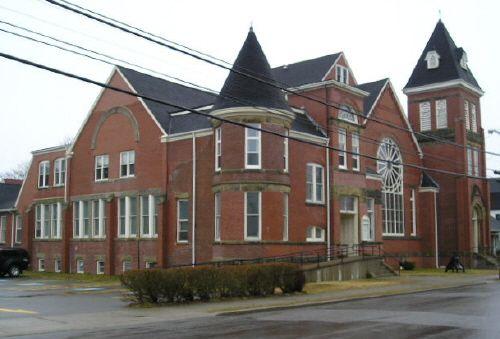
Zion Church is a Municipal Heritage Property located on two lots on Main Street North in downtown Moose Jaw. The property includes a three-storey stone and brick-clad church completed in 1907.
Heritage Value
The heritage value of the property lies in its architecture. Designed with elements of the Classical Revival style of architecture the building is symmetrical in design and includes pediments, cornice with dentils, a centrally placed dome and an imposing entrance comprised of five columns and an entablature. The property was designed by Winnipeg architect James Chisholm. In 1906, in hopes of accommodating greater future growth, the congregation engaged Chisholm to adapt his design for Winnipeg’s Zion church for their own new place of worship on Main Street. Moose Jaw’s Zion Church was Chisholm’s only commission in the city.
The heritage value of the property also lies in the heritage integrity of the church interior. The interior was designed to facilitate a column free space, with a large dome floating over the congregation. The church is adorned with a circular stained-glass window prominently located in the dome above the sanctuary along with other original stained glass windows that exhibit religious symbolism or serve as memorials to early church members. The acoustics of the sanctuary enhance the performance of a pipe organ that was manufactured and installed in the chancel by the Casavant Brothers of St. Hyacinthe, Québec in 1907. Aside from the addition of an elevator and four columns to support the dome constructed in 1975, Zion’s interior remains largely unchanged from its original design.
The heritage value of Zion Church also lies in its close connection with many of Moose Jaw’s pioneers. Shortly after settlement in 1883 the Methodists were the first religious group to organize worship services and build a church in the community. The Methodist congregation grew rapidly in the ensuing two decades forcing the construction of two successively larger churches.
The heritage value of the property also lies in its prominence in the downtown streetscape. Located on the city’s main thoroughfare the church maintained its sense of prominence despite the rise of taller buildings on lots nearby. Zion’s prominence is also aided by its location at the terminus of a vista created where tree-lined Stadacona Street West meets Main Street. The church’s generous scale, its fieldstone base, finials, pronounced keystones, stone lintels and mouldings, decorative brick work and the dome’s octagonal base and ornate metal crown add to its enduring prominence in the city’s downtown.
Source:
City of Moose Jaw Bylaw No. 4171, 1983.
Character-Defining Elements
The heritage value of Zion Church resides in the following character-defining elements:
-the association of the property with pioneers to the City of Moose Jaw, including its cornerstone and stained glass windows that serve as a memorial to early residents of the city;
-the Classical Revival style of its architecture, including its symmetrical design, pediments, cornice with dentils, centrally placed dome and imposing entrance comprised of five columns and an entablature;
-those other elements which add to the prominence of the property, such as its generous scale, its fieldstone base, finials, pronounced keystones, stone lintels and mouldings, decorative brickwork, the dome’s octagonal base, ornate metal crown and its present prominent location on its original site at the intersection of Main Street North and Stadacona Street West;
-those interior elements which are indicative of its heritage integrity and its use as a place of worship including its sanctuary and gallery which hold a communion table, stone baptismal font, its extensive use of varnished oak in mouldings, panels and pews, its stained glass windows and Casavant pipe organ.
Gallery
1 imageLocation
Loading map...
Similar Places
Heritage sites with similar characteristics