Provincial Heritage Site
Wanipigow Lake Archaeological Site
Unorganized, Manitoba
Also known as Wanipigow
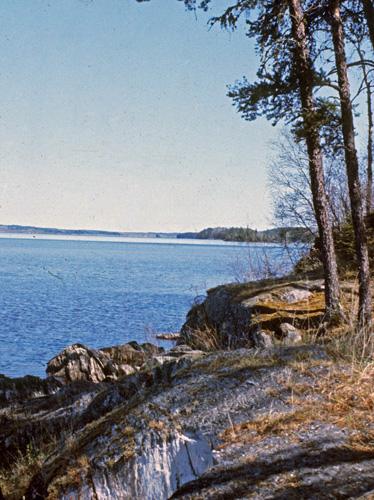
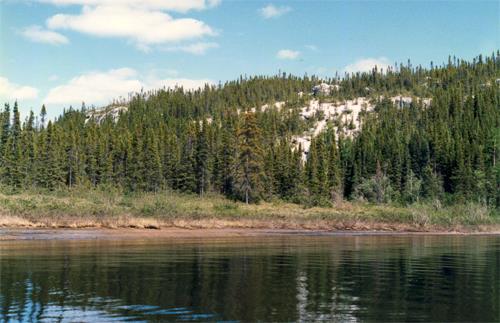
Contextual view of the Wanipigow Lake Archaeological Site, Wanipigow Lake, 1989
Photo: Historic Resources Branch, Manitoba Culture, Heritage, Tourism and Sport, 1989
- Recognized
- 1980
- By
- Province of Manitoba
The register’s text, word for word
Description
The Wanipigow Lake Archaeological Site, consisting of archaeological artifacts and features, is situated on well-forested, low-lying ground on the rocky southeastern shore of Wanipigow Lake in eastern Manitoba. The provincial designation applies to the approximately 50,000-square-metre parcel of land, including a short peninsula and an area adjacent to a small bay, and excluding a block of centrally located cottages.
Heritage value
The Wanipigow Lake Archaeological Site, one of the most significant in Manitoba, is valued for the wealth of information it contains about indigenous habitation over the past six millennia in the boreal forest east of Lake Winnipeg. Archaeological recoveries indicate the most intensive use of the site began about 2000 years ago with the Laurel people (named for their distinctive pottery, the oldest identified in Manitoba), followed successively by other groups, as revealed by Blackduck, Selkirk and Sandy Lake pottery types, among other artifacts. The Laurel presence, along with evidence of local harvesting of wild rice and goosefoot, are especially notable. They represent important shifts in Aboriginal lifeways from reliance on grassland resources to forest and aquatic resources, and from subsistence strategies based on small nomadic groups toward larger, more socially complex and seasonally sedentary concentrations of people. The natural advantages which made the Wanipigow site attractive, such as many nearby water bodies and a seasonal abundance and diversity of flora and fauna, are still apparent. This extensively researched site has contributed much to the field of archaeology in Manitoba and to the understanding of the province's early boreal forest inhabitants.
SourceMinister in Charge of Tourism and Cultural Affairs, June 19, 1980
Character‑defining elements
Key elements that define the locational character of the Wanipigow Lake Archaeological Site include:
- the natural and original setting on the southeastern shore of Wanipigow Lake, part of the Canadian Shield lying east of Lake Winnipeg that contains boreal forest, numerous rivers, creeks, lakes and marshes, etc.
- the natural terrestrial vegetation and proximity to aquatic resources
Key elements that define the site's physical and cultural character include:
- the elements that reflect precontact use, including the undisturbed cultural stratigraphy and numerous archaeological remains, such as artifacts, bone, hearths, stone constructions and other cultural features, especially any material in its original context
- the sequence of natural soil layers with their contained organic remains that are evidence of the site's past environments
- the use of the name Wanipigow, a Cree word for 'hollow water' or 'hole in the water', which corresponds to a local legend
End of the register’s text
Location
Division No. 19, Unorganized, Manitoba, R0E, Canada
51.07777° N, 95.90833° W
Get directions (opens in a new tab)Being on the register doesn’t make a place open to visitors. Many are private homes or businesses; please view them from the street.

Loading map…
Similar places
Places whose register descriptions are closest to this one.
 Wanuskewin National Historic Site of CanadaSaskatoon, Saskatchewan
 Mud Lake Stream Anthropological SiteNorth Lake, New Brunswick
 Arden Mound and Camp SiteLansdowne, Manitoba
 Waapushukamikw National Historic Site of CanadaWildlife sanctuary of Lacs Albanel-Mistassini-et-Waconichi / Réserve faunique des Lacs Albanel-Mistassini-et-Waconichi, Quebec
 Apitipik National Historic Site of CanadaPikogan, Quebec
 The Forks National Historic Site of CanadaWinnipeg, Manitoba
From the Canadian Register of Historic Places, as last updated on December 12, 2025. The register’s text is shown word for word.