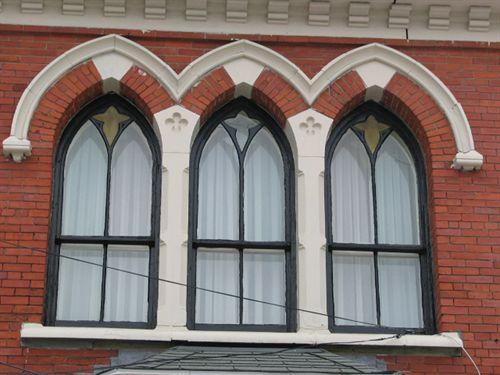
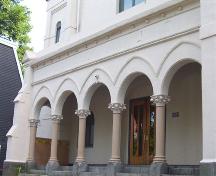
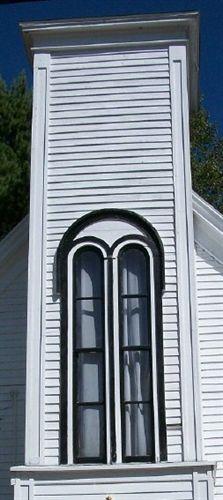
Universalist Church, detail of second storey front elevation window, Halifax, Nova Scotia, 2005.
Photo: Heritage Division, NS Dept. of Tourism, Culture and Heritage, 2005.
- Built
- 1878
- Recognized
- 1997
- By
- Local government
The register’s text, word for word
Description
Universalist Church is a two-and-a-half brick masonry building in the Gothic Revival style. It is located on the west side of Brunswick Street in Halifax, Nova Scotia. This structure is the right half of a townhouse style building that continues in the same form and detailing. Brick Gothic Revival style buildings are common in British and other North American cities during the late nineteenth century but are considered rare in Halifax. The heritage designation applies to the building and the lot it occupies.
Heritage value
Universalist Church is valued for its association with the West family, its architect, and the evolution of the development along Brunswick Street in Halifax. The West family was a wealthy and prominent family in early Halifax. This wealth permitted them to contribute substantially to their church. They hired the architectural firm of Elliot and Busch to design and build the Universalist Church in 1878. They were also hired to design the West family home nearby on the same street. Henry Elliot, architect, was also a member of the Universalist congregation. This original purpose of this building was to provide income for the church. It was a rented dwelling that continued this purpose well into the twentieth century. Luckily, the 1917 Halifax Explosion caused only minor damage. In the 1940s, during an economic decline on Brunswick Street, the church sold the property for less than their construction original investment.
Universalist Church is valued for its Gothic Revival style. The brick masonry of the Universalist Church continues along the same lines and detailing of its adjoining building. This gives the building a terrace or townhouse effect even though they are separate properties. The Gothic Revival details of the exterior provide interest to the street. The most notable and signature feature of the Gothic Revival style is the second storey window arcade with pointed arches, stone arches and wooden tracery. The mansard roof, with truncated dormers is more characteristic of the Second Empire style, but used often in the construction of urban homes during this time period. Another interesting feature of the Universalist Church is the bay window more commonly associated with the Queen Anne Revival style. The interesting nature and form of this structure continues to be important to the street and its surrounding neighbourhood.
SourceHeritage Property File: 2146 Brunswick Street, Universalist Church, found at HRM Planning and Development Services, Heritage Property Program, 6960 Mumford Road, Halifax, Nova Scotia.
Character‑defining elements
The character-defining elements of the Universalist Church related to its Gothic Revival style include:
- brick masonry construction;
- second storey window arcade;
- pointed windows;
- stone archways;
- decorative wooden tracery in the windows.
Other character-defining elements of the Universalist Church include:
- mansard roof and truncated dormers more typical of Second Empire style;
- bay window more typical of Queen Anne Revival style;
- contrasting stone trim.
End of the register’s text
Location
2146 Brunswick Street, Halifax, Nova Scotia, B3K, Canada
44.65296° N, 63.58200° W
Get directions (opens in a new tab)Being on the register doesn’t make a place open to visitors. Many are private homes or businesses; please view them from the street.

Loading map…
Similar places
Places whose register descriptions are closest to this one.
 Universalist Unitarian Church of HalifaxHalifax, Nova Scotia
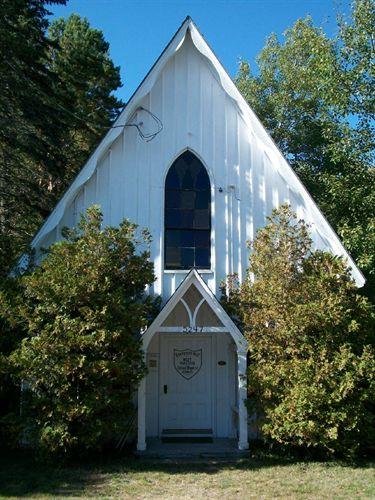 Evergreen United Baptist ChurchWest Paradise, Nova Scotia
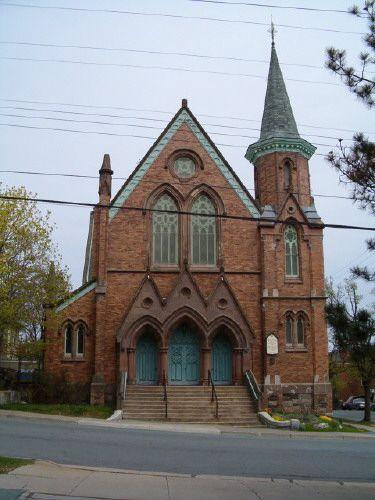 Fort Massey United ChurchHalifax, Nova Scotia
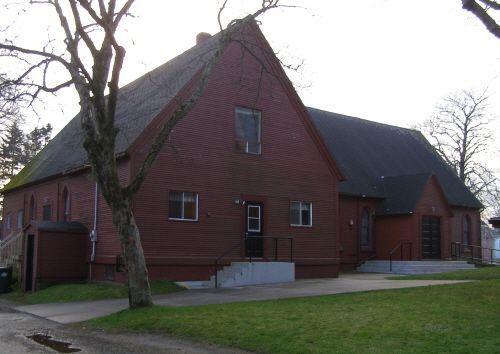 Holy Trinity Anglican Parish HallYarmouth, Nova Scotia
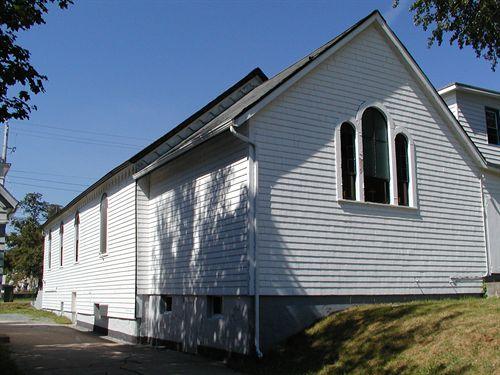 Victoria Road United Baptist ChurchDartmouth, Nova Scotia
 Milford United Baptist ChurchMilford, Nova Scotia
From the Canadian Register of Historic Places, as last updated on December 12, 2025. The register’s text is shown word for word.