National Historic Site of Canada
Sharon Temple National Historic Site of Canada
East Gwillimbury, Ontario
Corner view of the Sharon temple, showing the superimposed cubic forms, 1991.
Photo: Parks Canada Agency/ Agence Parcs Canada, 1991.
- Built
- 1825–1831
- Recognized
- 1990
- By
- Government of Canada
The register’s text, word for word
Description
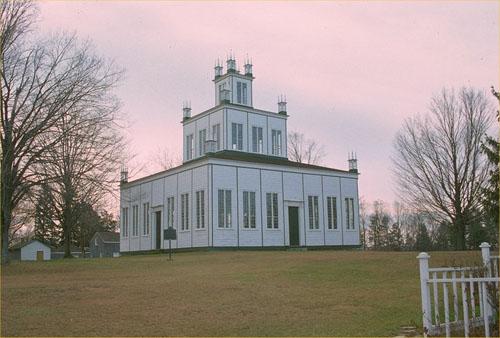
Sharon Temple National Historic Site of Canada is located north of Toronto, in the village of Sharon. It is an elegant wooden building comprised of three storeys of diminishing size. All four sides of the building are filled with large windows that are candle-lit for special celebrations. The Temple sits in the centre of a large, grassed area, which also contains a collection of other buildings associated with the religious community. The designation refers to the Temple on its lot.
Heritage value
Sharon Temple was designated a National Historic Site of Canada in 1990 because:
- of its aesthetic qualities, symbolism and structural design, as an embodiment of the values of he Children of Peace, and as an early example of the conservation of an historic building in Canada.
Its heritage value resides in the quality of its Neo-classical design and pioneer craftsmanship and in its physical manifestation of the beliefs of the Children of Peace who established a co-operative community north of Toronto named Sharon, known at that time as Hope. The temple was built by the members of the community between 1825 and 1831 to the designs of David Willson, the community leader, under the direction of master carpenter Ebenezer Doan. The last service was held in the Temple in 1889. In 1917, it was acquired by the York Pioneer and Historical Society, which started restorations and developed it as an historic site, moving additional buildings to the property over the years.
SourceHistoric Sites and Monuments Board of Canada, Minutes, 1990; Commemorative Integrity Statement.
Character‑defining elements
The key character-defining elements that contribute to the heritage character of this site include:
- its isolated setting in a green space;
- its related collection of other buildings associated with the religious community;
- its superimposed cubic forms and classically-inspired proportions;
- the use of traditional, largely wooden construction materials;
- its open, light-infused interior space with focus on the central Ark;
- its symmetrical design of four façades, each ground floor facade with a central doorway flanked by large, evenly-spaced, multi-paned windows;
- the slender, linear quality of its neo-classical detailing, emphasized by the use of contrasting paint colours;
- the fine craftsmanship;
- the objects directly related to the Children of the Peace, including the Ark, the original chairs used in the temple, the banners by Richard Coates, the candle holders, and the archival material and musical instruments.
End of the register’s text
Location
18974 Leslie Street, East Gwillimbury, Ontario, L9N, Canada
44.10116° N, 79.44132° W
Get directions (opens in a new tab)Being on the register doesn’t make a place open to visitors. Many are private homes or businesses; please view them from the street.

Loading map…
Nearby
Similar places
Places whose register descriptions are closest to this one.
 Old Stone Church National Historic Site of CanadaBeaverton, Ontario
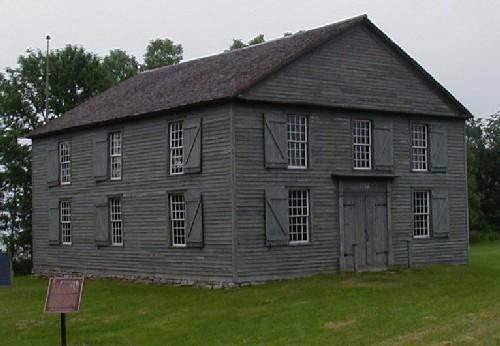 Old Hay Bay Church National Historic Site of CanadaGreater Napanee, Ontario
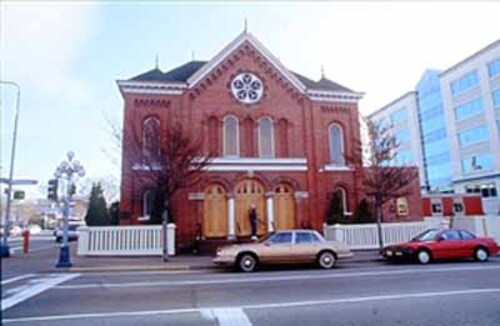 Congregation Emanu-el Temple National Historic Site of CanadaVictoria, British Columbia
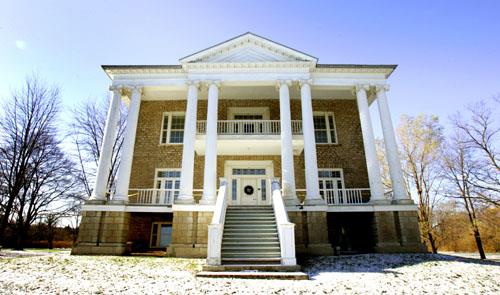 Willowbank National Historic Site of CanadaNiagara-on-the-Lake, Ontario
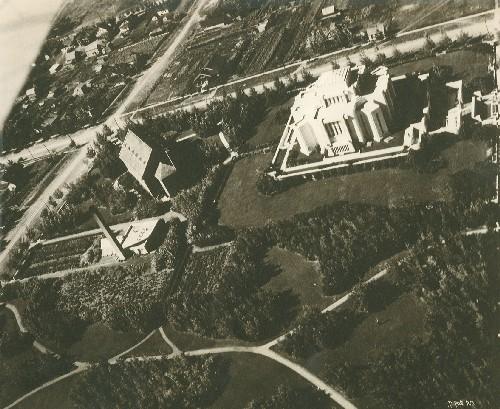 Temple of the Church of Jesus Christ of Latter Day Saints National Historic Site of CanadaCardston, Alberta
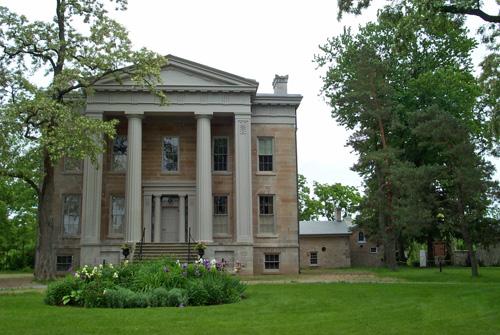 Ruthven Park National Historic Site of CanadaHaldimand, Ontario
From the Canadian Register of Historic Places, as last updated on December 12, 2025. The register’s text is shown word for word.