National Historic Site of Canada
Sea Horse Gully Remains National Historic Site of Canada
Churchill, Manitoba
Also known as Sea Horse Gully Remains, Vestiges du ravin des Morses
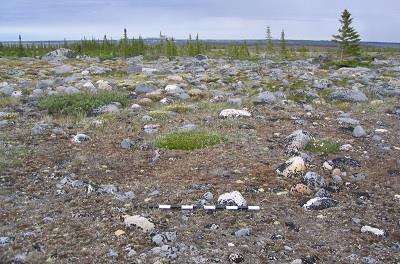
General view of Sea Horse Gully Remains, showing excavations associated with Dorset House No. 1, 1968.
Photo: Dr. David Meyer, 1968.
- Recognized
- 1969
- By
- Government of Canada
The register’s text, word for word
Description
The Sea Horse Gully Remains National Historic Site of Canada is located on a peninsula forming the west site of the Churchill River, directly opposite the town of Churchill, Manitoba. Set on the northernmost segment of a bedrock ridge, the site is covered by a layer of gravel, stones and sand. The site comprises two archaeological components: the Sea Horse Gully site, which runs 1.8 kilometres along the length of a bedrock ridge at the height of the peninsula 30 metres above sea level and the Dorset Cove site, located on the western side of the peninsula near Button Bay, measuring 400 by 300 metres that is 18-22 metres above sea level. Official recognition refers to the geographic location of the two archaeological sites circumscribed by defined boundaries.
Heritage value
Sea Horse Gully Remains was designated a national historic site of Canada in 1969 because:
- it contains one of the larger Dorset and Pre-Dorset assemblages in Canada.
The Sea Horse Gully site was discovered in 1966 by Joe Bighead, a local Chipewyan man. In the summer of the same year, a wildfire destroyed the mat of tundra vegetation that covered the sites revealing artifacts and rock patterns of structures visible on the ground surface. A year later, further excavations uncovered 24 Pre-Dorset dwellings, as well as a large tool assemblage, domestic artifacts and other surface findings. The variety of large tools found at Sea Horse Gully are virtually unique as the only other site where similar tools have been discovered is the Twin Lakes site southeast of Churchill. The site is believed to have been occupied 500 BCE and 130 BCE. It is one of the larger Pre-Dorset and Dorset sites in terms of number of artifacts.
SourceHistoric Sites and Monuments Board of Canada, Minutes, 1969 and 2009.
Character‑defining elements
Key elements that contribute to the heritage character of the site include:
- its location on a peninsula forming the western side of the Churchill River, overlooking the Hudson Bay, in Manitoba;
- its setting on and below a ridge, which is covered by an unconsolidated mantle of gravel and cobbles;
- the composition and integrity the 24 Pre-Dorset dwellings, their outlines indicted by rings of stones, in their original placement, extent and interrelationship;
- the integrity of any surviving or as yet unidentified archaeological remains which may be found within the site in their original placement and extent including both microtools and larger tools including domestic artefacts such as burins, burin spalls, blades, harpoon points, large and small bi-faces, adzes, gouges, knives and end scrapers;
- the surrounding viewscapes to and from Churchill, across the Churchill River, and out to Hudson Bay.
End of the register’s text
Location
West pennisula, Churchill River, Churchill, Manitoba, R8N, Canada
58.77022° N, 94.26708° W
Get directions (opens in a new tab)Being on the register doesn’t make a place open to visitors. Many are private homes or businesses; please view them from the street.

Loading map…
Similar places
Places whose register descriptions are closest to this one.
 Seal Cove Smoked Herring Stands National Historic Site of CanadaGrand Manan, New Brunswick
 Port Refuge National Historic Site of CanadaDevon Island, Nunavut
 Boat Encampment National Historic Site of CanadaRed Rock Bay, British Columbia
 Head-Smashed-In Buffalo Jump National Historic Site of CanadaFort MacLeod, Alberta
 Port au Choix National Historic Site of CanadaPort au Choix, Newfoundland And Labrador
 Hay River Mission Sites National Historic Site of CanadaHay River Indian Reserve, Northwest Territories
From the Canadian Register of Historic Places, as last updated on December 12, 2025. The register’s text is shown word for word.