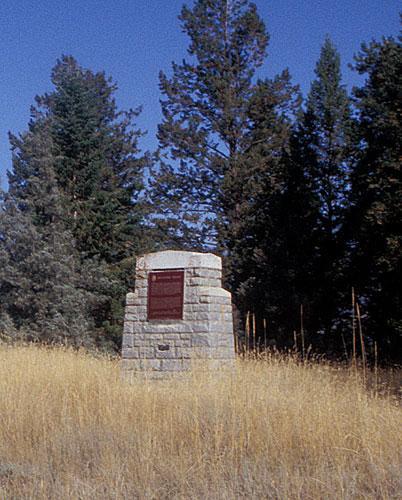
Rocky Mountain House National Historic Site of Canada
Also known as: Rocky Mountain House National Historic Site of Canada, Rocky Mountain House, Rocky Mountain House
Description
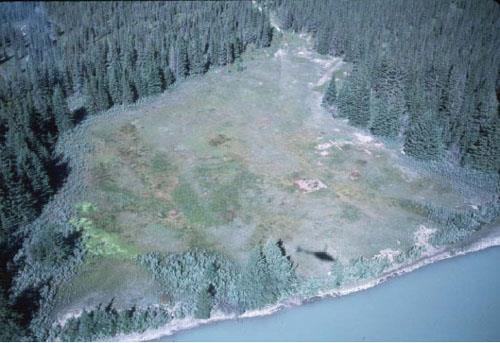
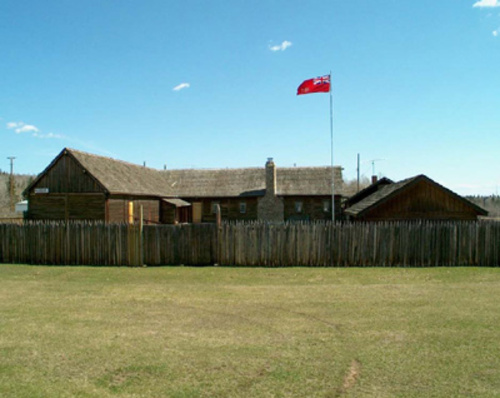
Rocky Mountain House National Historic Site of Canada is an archaeological site that contains the remains of several early 19th-century fur trade forts known as Rocky Mountain House. It is located on the North Saskatchewan River at Brierly Rapids, which was historically an obstacle to navigation. The designation refers to the remains of trading establishments built and occupied between 1799 and 1875 on the west bank of the North Saskatchewan River above its confluence with the Clearwater River together with an associated burying ground.
Heritage Value
Rocky Mountain House has been designated a national historic site because of :
- its role in the historic fur trade,
- its association with David Thompson and ''exploration towards the westward'',
- its relationship with the Blackfoot peoples (Nitsitapi) particularly the Peigan (Pikani).
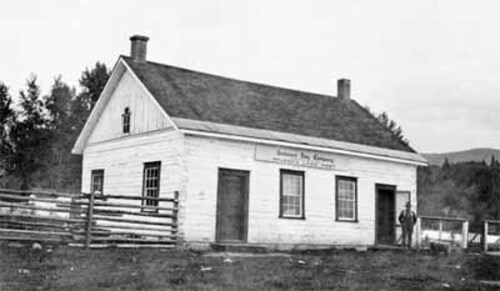
The heritage value of Rocky Mountain House lies in its historical associations as illustrated by its setting and archaeological remains. Rocky Mountain House was established by the Northwest Company in 1799 on a site frequented by the Blackfoot people, and close to Acton House, established nearby by the Hudson's Bay Company at the same time. It served initially as a post on the transcontinental route, then as a fur trade and provisioning post and boat-building operation, then as the focal point of the Hudson's Bay Company's strategy towards the American competitors on the Missouri River. Its occupation was not continuous during the fur trade, and posts were rebuilt and replaced over the years using at least four different sites (1799-1821, 1835-1861, 1868-1875 and the site of Acton House, 1799-1835, respectively). After 1875 there was no permanent occupation of the site.
Sources : Historic Sites and Monuments Board of Canada, Minutes, 1968; Commemorative Integrity Statement, 1998.
Character-Defining Elements
Key elements contributing to the heritage value of this site include:
- archaeological remains of the four post sites and the archaeological evidence they contain concerning the composition, materials, technology, functions and settings of individual structures;
- the footprints of the post sites and their spatial relationships to one another;
- the burying ground in its integrity, extent and location;
- evidence of fur trade and Blackfoot, especially Peigan, life during the 1799-1875 period, both above and below ground (such as surviving evidence of middens and canoe landing sites);
- archaeological artifacts removed from the site and held by Parks Canada;
- the natural setting of the site (its undisturbed river terraces);
- the natural vegetation of the site (its riverine spruce forest);
- its location adjacent to Brierly Rapids on the North Saskatchewan River;
- viewscapes from the site up and down the North Saskatchewan River valley;
- viewscapes to the sites of earlier and later settlement on adjacent property.
Gallery
3 imagesLocation
Loading map...
Similar Places
Heritage sites with similar characteristics