Provincially Registered Property
Randall House
Wolfville, Nova Scotia
Also known as Randall House Museum
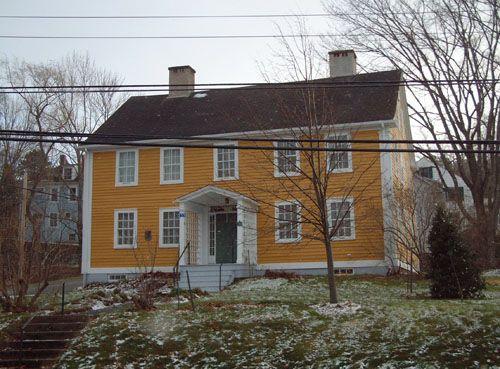
Front elevation of Randall House, Wolfville, NS, 2006.
Photo: Heritage Division, NS Dept. of Tourism, Culture and Heritage, 2006.
- Recognized
- 1987
- By
- Province of Nova Scotia
The register’s text, word for word
Description
Randall House is a late eighteenth-century, two-and-one-half storey, wooden farmhouse located in Wolfville. With its colourful exterior and central location on the corner of Main Street and Victoria Avenue, the home is a prominent feature of the town. The house, which has retained its New England colonial character, is situated on a hill overlooking what used to be Wolfville's bustling harbour, and to the west of what was once Mud Creek, and is now Willow Park. The building and property are included in the designation.
Heritage value
Randall House is valued for its age as it is one of the two oldest houses in Wolfville. It is also valued architecturally as its exterior has been well maintained to reflect its original New England Colonial style; and its Georgian interior has been meticulously restored to house the museum of the Wolfville Historical Society.
The construction date of Randall House is unclear. The property changed hands nine times between 1761 and 1780, which was not uncommon as people in the Horton Township frequently traded lots to consolidate their property. Beginning in 1769, the deeds to the Randall House property mention a dwelling; however, it is unclear if the dwelling is Randall House. In 1780, Thomas Caldwell of Horton purchased the land. In February 1786, he sold the property and its buildings, which included a dwelling, barn, and outhouses, to Halifax merchants Thomas, James, and William Cochrane. It is most likely during this period of ownership that Randall House was constructed.
Due to economic ebbs and flows, the property exchanged hands many times over the following year. Between 1808 and 1812, it was owned by Aaron Cleveland, a cooper who established his trade on the property. The lot's location in the commercial centre of Horton Township would have been an excellent spot for business. Charles Randall purchased the house in 1812 and the property stayed in his family for one hundred and fifteen years. However, by 1927 the years had taken their toll on the house, which was in such poor condition it had become virtually uninhabitable.
Charles Patriquin, a retired farmer, bought the property in 1927 and with the support of his wife and family, repaired the neglected building. In 1947, he sold the house to the Wolfville Historical Society, and in May 1949, it became the town's museum.
SourceProvincial Heritage Program property files, no. 56, 1747 Summer Street, Halifax, NS.
Character‑defining elements
Character-defining elements of Randall House include:
- two-and-a-half storey, wood construction;
- steep-pitched gable roof;
- central doorway with symmetrical five bay façade;
- clapboard siding with wide corner boards;
- returning eaves with cornice;
- matching concrete chimneys;
- flat transom window with sidelights above front door;
- pedimented gable porch on Doric columns with latticed sides;
- all original interior elements including: dry wall stone cellar with earthen floor; bake oven; original floor; and seven original fireplaces;
- its central location in the Town of Wolfville.
End of the register’s text
Location
259 Main Street, Wolfville, Nova Scotia, B4P, Canada
45.09196° N, 64.35532° W
Get directions (opens in a new tab)Being on the register doesn’t make a place open to visitors. Many are private homes or businesses; please view them from the street.

Loading map…
Similar places
Places whose register descriptions are closest to this one.
From the Canadian Register of Historic Places, as last updated on December 12, 2025. The register’s text is shown word for word.