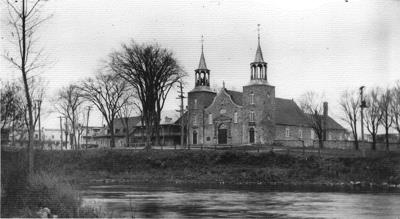
Notre-Dame-des-Victoires Church National Historic Site of Canada
Also known as: Notre-Dame-des-Victoires Church National Historic Site of Canada, Notre-Dame-des-Victoires Church, Église Notre-Dame-des-Victoires
Description
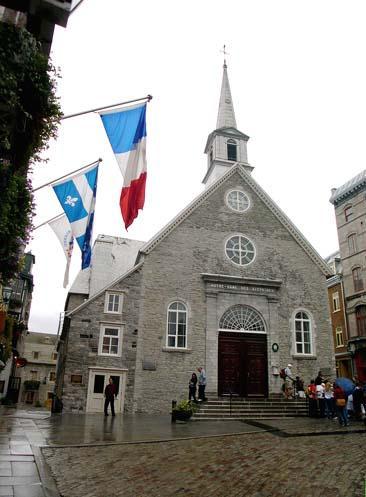
Notre-Dame-des-Victoires Church National Historic Site of Canada is prominently located in Place Royale in Québec’s lower town. Built on the site of the first permanent French establishment in North America, the site is associated with the growth of the city of Québec and its inhabitants. The church was constructed of stone in the Québec’s vernacular style in 1688, and remains a symbol of the French presence in North America. Constructed with both neoclassical and Palladian influences, the building features a symmetrical façade, a wide pediment and cut-stone pilasters. The official designation refers to the church’s legal property at the time of designation.
Heritage Value
The Notre-Dame-des-Victoires church was designated a National Historic Site of Canada in 1988 because:
- of its strong associations with the development and the people of Québec.
Built as an annex for the Notre-Dame-de-Québec church, the Notre-Dame-des-Victoires Church was constructed in 1688 on the site of the first permanent French establishment in North America. It was the same site of Champlain’s Habitation constructed in 1608. The church was named for the two French victories over British fleets in 1690 and 1711. It has undergone many transformations beginning with the building of the first walls in 1688 and the first permanent façade in 1723. The church was destroyed during the siege of 1759 but, owing to popular interest in this place of worship, it was rebuilt.
The church is a good illustration of the evolution of ecclesiastical architecture in Québec. It retains its 17th-century plan and traditional stone construction, which identify it with the church architecture of New France and connect it to the works of some of the French Regime’s well-known architects such as, Claude Baillif, Jean-Baptiste Maillou and Thomas Baillairgé. In addition, its façade represents an important period in the architectural development of Québec churches when Neoclassical forms began to take over traditional forms. It is also one of the few surviving works by François Baillairgé.
Source: Historic Sites and Monuments Board of Canada, Minutes, June 1988.
Character-Defining Elements
The key elements relating to the heritage value of the site include:
- its prominent location at the centre of Place Royale, in Québec’s lower town;
- its simple plan, rectangular volume, symmetrical façade and gable roof;
- the thick stone masonry of the exterior walls;
- exterior elements exhibiting Palladian influences, including the wide pediment, the oculus windows, and the pilasters framing the central portal;
- exterior elements exhibiting Neoclassical influences, including classical motifs, niches, and keystone arches;
- any traces of the church’s stylistic evolution since its original construction;
- any remaining elements of the 17th century masonry structure.
Gallery
2 imagesLocation
Loading map...
Similar Places
Heritage sites with similar characteristics