Municipally Registered Property
Mary Queen of Scots House
Halifax, Nova Scotia
Also known as Queen of Scot's Head, Queen Anne House
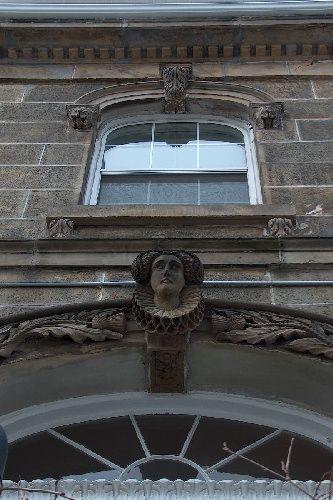
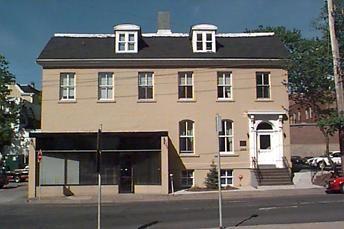
Mary Queen of Scots House, Halifax, Nova Scotia, 2007.
Photo: HRM Planning and Development Services, Heritage Property Program, 2007.
- Built
- 1861
- Recognized
- 1982
- By
- Local government
The register’s text, word for word
Description
Mary Queen of Scots House is a one-and-a-half storey stone structure in the Georgian style. It is located on Queen Street in Halifax, Nova Scotia. The heritage designation applies to the building and the lot it occupies.
Heritage value
Mary Queen of Scots House is valued for its association with its occupants. The house is also known as Queen of Scot's Head and the Queen Anne House. The house was constructed in 1861 by George Blaiklock of the firm of Henry & Blaiklock, Builders. One of the first occupants was Supreme Court Judge, Joseph Norman Ritchie. His brother, John William Ritchie, also lived in the Mary Queen of Scots House. John Ritchie was a Solicitor General of Nova Scotia, Member of Legislative Council from 1864 to 1867, a father of Confederation, member of the Canadian Senate in 1867, and Supreme Court Judge. He also helped produce the first series of revised statutes of Nova Scotia.
Other relevant individuals who resided in this building inlcude Dr. George McCawley, the first president of King's College in Windsor, NS; well known furniture manufacturer, wholesaler and retailer Alexander Stephen; prominent merchant John Cummings; and Miss Susannah Almon, who is responsible for having had the stone head of Mary added to the house above the central door. The stone head was carved by stone cutter George Laing who also lived in the house. Laing was a well-known stone carver who carved the lion on Sebastian Monument, and the detailed carvings on the Halifax Club (Hollis Street) and the Nova Scotia Court House (Spring Garden Road).
Mary Queen of Scots House is also valued for its Georgian architectural style. The one-and-half storey stone house has a solid appearance, and is symetrically designed with a central entrance. The building has a sandstone stringcourse and window sills, arched windows with keystones and an arched doorway with a likeness of Mary Queen of Scots carved above the main entrance.
SourceHeritage Property File: 1266 Queen Street, Mary Queen of Scots House, found at HRM Planning and Development Services, Heritage Property Program, 6960 Mumford Road, Halifax, Nova Scotia.
Character‑defining elements
The character-defining elements of the Mary Queen of Scots House include:
- symmetrically arranged facade;
- stone construction;
- sandstone ornamentation and decorated window sills;
- round headed windows with sandstone window hoods with carved stone detailing;
- sandstone stone carving of Mary Queen of Scots head above the main entrance;
- low pitched roof, with dentils in the cornice;
- recessed arched doorway.
End of the register’s text
Location
1266 Queen Street, Halifax, Nova Scotia, B3J, Canada
44.64032° N, 63.57469° W
Get directions (opens in a new tab)Being on the register doesn’t make a place open to visitors. Many are private homes or businesses; please view them from the street.

Loading map…
Similar places
Places whose register descriptions are closest to this one.
From the Canadian Register of Historic Places, as last updated on December 12, 2025. The register’s text is shown word for word.