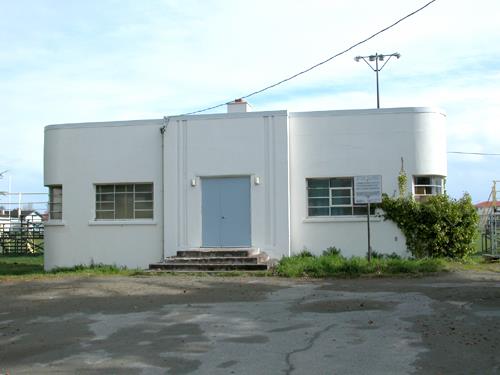
Maritime Naval Communications Centre, exterior view, 2004.
Photo: Derek Trachsel, District of Saanich, 2004
- Built
- 1939–1940
- Recognized
- 1997
- By
- Local government
The register’s text, word for word
Description
The Maritime Naval Communications Centre is a one-storey, stucco-clad, masonry flat-roofed Streamline Moderne building. It is located on the campus of the University of Victoria, in the Gordon Head area of Saanich.
Heritage value
The heritage value of the Maritime Naval Communications Centre is associated with its development within its neighbourhood context. Gordon Head is bordered on the north and east by Haro Strait and on the west by Blenkinsop Valley and Mount Douglas. First settled by farmers, starting with James Todd in 1852, Gordon Head became famous for its strawberries and then its daffodils. In 1921, city water service was brought to Gordon Head, leading to a proliferation of greenhouses and vegetable farming. Since the 1950s, the area has gradually been developed with single-family housing.
The Maritime Naval Communications Centre is of heritage value for its association with Canada's role in the Second World War. The construction of a wireless (radio) station on the site was planned in late 1939 by the Department of Transport. However, the building was used as a Maritime Naval Communications Centre; during the war it was surrounded by a high barbed-wire fence, guarded by sentries, and off-limits to personnel at the adjacent Gordon Head Military Camp. The basement contained power-generating equipment, and the wireless equipment, located on the first floor, was connected to a radio mast some distance away.
Architecturally, the building is of significant value as a fine example of the Streamline Moderne style, rare in Saanich and the surrounding districts. Designed to suit functional requirements, it followed a pure expression of the style, based on pure form rather than detailing. The construction was exceptionally robust, for maximum protection of the equipment; the walls are parged red clay tile blocks approximately 30 centimeters thick, and the basements walls, main floor and roof are 30 centimeter thick concrete. The building was designed to look like a house, with a circular formal drive in front to act as camouflage from the air.
SourceHeritage Planning Files, District of Saanich
Character‑defining elements
Key elements that define the heritage character of the Maritime Naval Communications Centre include its:
- location on the campus of the University of Victoria near the surviving World War Two Army Huts
- form, scale and massing, including its solid, heavy construction for military purposes
- Moderne elements such as smooth stucco exterior walls; flat roof with small ledge at roof-line; horizontality of the elevation; the curved windows; and the vertical fluting on each side of the front door
- steel sash windows with narrow profile muntins
- the circular drive in front
End of the register’s text
Location
2260 McCoy Road, Saanich, British Columbia, V8N, Canada
48.46923° N, 123.31389° W
Get directions (opens in a new tab)Being on the register doesn’t make a place open to visitors. Many are private homes or businesses; please view them from the street.

Loading map…
Nearby
All 67 places in Saanich



Similar places
Places whose register descriptions are closest to this one.
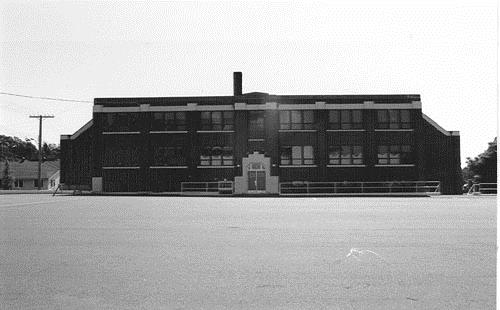 Communications School, Building 67Esquimalt, British Columbia
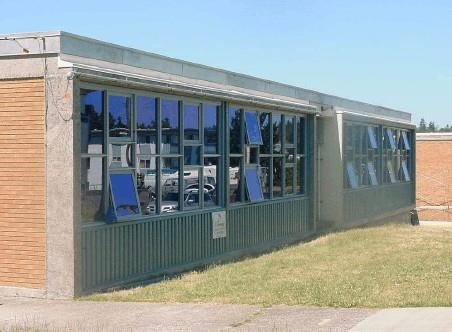 Radar Training BuildingEsquimalt, British Columbia
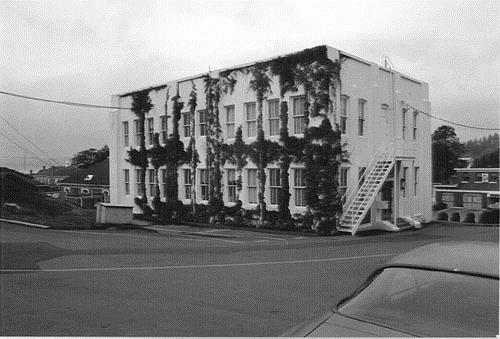 Former Offices of the Officer-in-ChargeEsquimalt, British Columbia
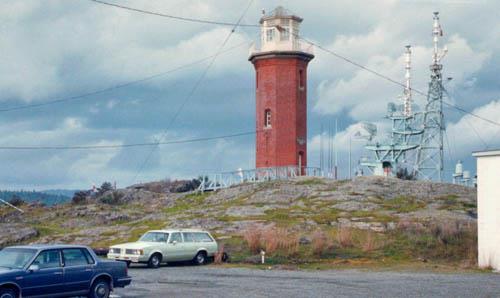 CFB Esquimalt, Bickford Tower, Building D118Esquimalt, British Columbia
 Gunnery School, former Building 50Esquimalt, British Columbia
 Torpedo School, former Building 2Esquimalt, British Columbia
From the Canadian Register of Historic Places, as last updated on December 12, 2025. The register’s text is shown word for word.