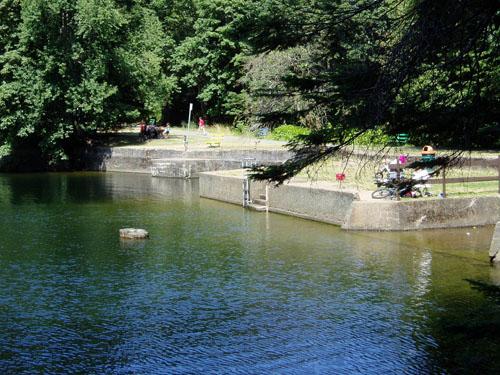
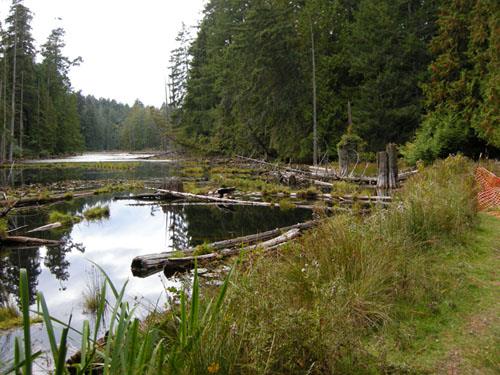
View of the Harewood Colliery Dam
Photo: City of Nanaimo, Christine Meutzner, 2006
- Built
- 1910–1911
- Recognized
- 2002
- By
- Local government
The register’s text, word for word
Description
The Harewood Colliery Dam is an early dam structure located in a municipal park on the edge of one of Nanaimo's oldest neighbourhoods, south west of the city core. The historic place consists of all the remaining components of the original dam.
Heritage value
The Harewood Colliery Dam is a rare, tangible link with Nanaimo's industrial heritage. Built in 1910-11 by the Western Fuel Company to supply water for coal washing and for use by miners, mules and horses in the mines, the water system quickly developed an important secondary use. Homes near the pipeline were allowed to tap the line for domestic uses and eventually this water was carried to most of the homes in South Harewood. The Harewood Colliery Dam symbolizes the important role the coal company played in the everyday lives of local residents.
The value of the Harewood Colliery Dam resides in its location in a municipal park, readily accessible to the public as a recreational and interpretive venue. The lake created by the dam provides a well-used outdoor swimming facility for the general public.
SourceCity of Nanaimo, Development Services Department
Character‑defining elements
The character-defining elements of the Harewood Colliery Dam include:
- all of the remaining components of the original dam including the concrete-faced, earthen dam and the concrete spillway.
- the dam's location within a municipal park.
End of the register’s text
Location
645 Wakesiah Avenue, Nanaimo, British Columbia, V9R, Canada
49.14843° N, 123.96568° W
Get directions (opens in a new tab)Being on the register doesn’t make a place open to visitors. Many are private homes or businesses; please view them from the street.

Loading map…
Similar places
Places whose register descriptions are closest to this one.
From the Canadian Register of Historic Places, as last updated on December 12, 2025. The register’s text is shown word for word.