Historic Site
Hamona Provincial Historic Site
Spy Hill RM 152, Saskatchewan
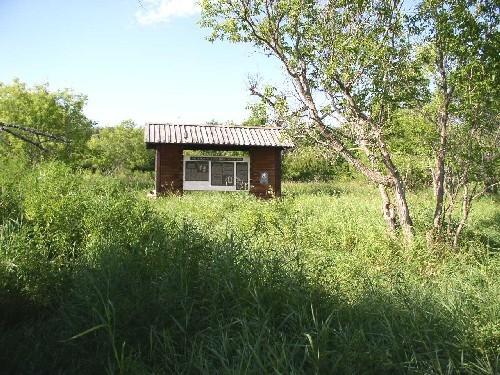
View north at interpretive panel, 2004.
Photo: Government of Saskatchewan, Marvin Thomas, 2004.
- Recognized
- 1986
- By
- Government of Saskatchewan
The register’s text, word for word
Description
The Hamona Provincial Historic Site comprises a one-half hectare parcel of rural land in the Qu’Appelle Valley, approximately 40 kilometres north of the Town of Moosomin. The property features archaeological remains of a late nineteenth-century agricultural settlement.
Heritage value
The heritage value of the Hamona Provincial Historic Site lies in its association with the beginnings of the co-operative movement in Saskatchewan. In 1895, in the midst of a severe economic depression, two brothers, William and Edward Paynter, and a small group of like-minded individuals from Beulah, Manitoba formed the Harmony Industrial Association. As a remedy to the perceived inequities of the prevailing competitive socio-economic system, the Association established "Hamona,” a utopian agricultural settlement intended to operate “. . . On the basis of cooperation, for the benefit of its members and mankind in general.”
Hamona was notable for its progressive social policies and operating principles, including guaranteed employment, a maximum 10 hour work day and equal pay for all jobs, free housing and education, health benefit insurance, a proposed family allowance, and social ownership of resources. Although familiar with Marx and Engels, Hamona’s founders described their philosophy as “cooperation, not communism,” and stressed that the Association was not to interfere with the exercise of individual preferences in all social, religious and domestic matters. Hamona’s ideology is well-encapsulated in a member’s statement: “In essentials unity; in non-essentials liberty.”
By the late 1890s, the settlement had a population of around 50 people, several residences, a large store, stable, ice house, carpenter shop, blacksmith shop and community wash house. The colony was largely self-sufficient and was selling surplus products to neighbouring merchants. However, differing philosophical views, less growth in membership than anticipated, and, perhaps most importantly, the failure to secure an easily accessible rail link, resulted in the dissolution of the colony in 1900. Nevertheless, several members went on to participate in co-operative ventures and political movements that helped forge Saskatchewan’s distinctive character, including the United Grain Growers, the Cooperative Elevator Company, Saskatchewan Municipal Hail Insurance, the Cooperative Creamery, and the Cooperative Commonwealth Federation (CCF).
Source:
Province of Saskatchewan, Order in Council 870/86, August 21, 1986.
Character‑defining elements
The heritage value of the Hamona Provincial Historic Site resides in the following character-defining elements:
-the site’s location on a parcel of undeveloped rural land in the Qu’Appelle Valley;
-structural remains related to the former settlement, such as cellars and foundations;
-artifacts deriving from the 1895-1900 occupation, especially any objects in their original location and context.
End of the register’s text
Location
Spy Hill RM 152, Saskatchewan, S0A, Canada
50.52735° N, 101.67333° W
Get directions (opens in a new tab)Being on the register doesn’t make a place open to visitors. Many are private homes or businesses; please view them from the street.

Loading map…
Nearby
Similar places
Places whose register descriptions are closest to this one.
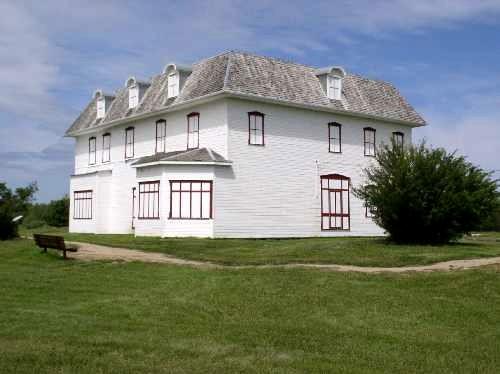 Cannington Manor Provincial ParkMoose Mountain RM 63, Saskatchewan
 South Branch House Provincial Historic SiteSt. Louis RM 431, Saskatchewan
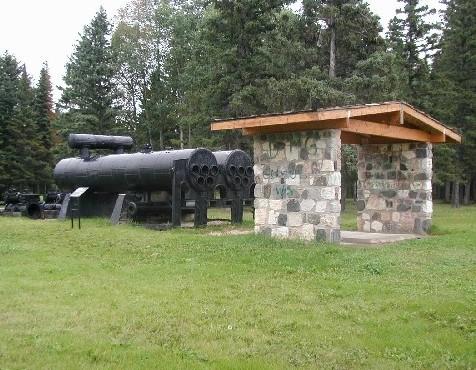 Cumberland House Provincial ParkCumberland House, Saskatchewan
 Fort Pelly #1 Provincial Historic SiteSt. Philips RM 301, Saskatchewan
 Claybank Brick PlantElmsthorpe RM 100, Saskatchewan
 Last Mountain House Provincial ParkLonglaketon RM 219, Saskatchewan
From the Canadian Register of Historic Places, as last updated on December 12, 2025. The register’s text is shown word for word.