Municipal Heritage Designation (Part IV)
Guelph Civic Museum
City of Guelph, Ontario
Also known as 6 Dublin Street South, Knights of Columbus Building, 21 Waterloo Avenue
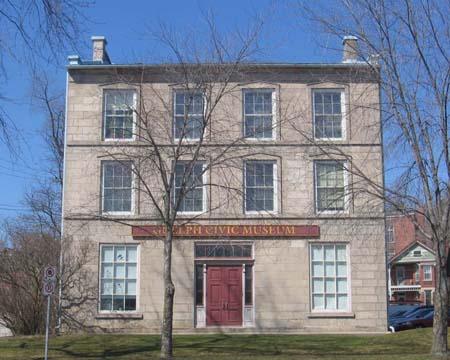
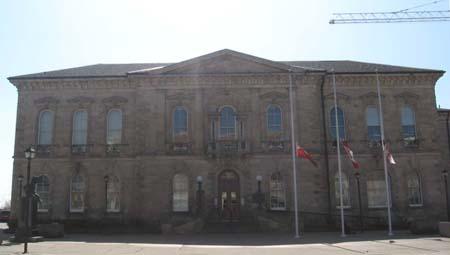
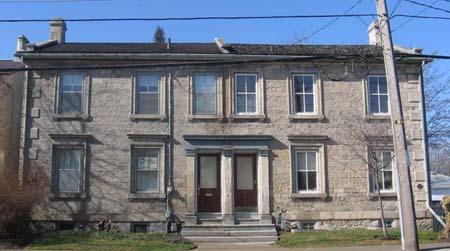
Of note are the upper storey bays and central front entrance.
Photo: Lindsay Benjamin, 2007.
- Built
- 1847
- Recognized
- 1977
- By
- Local government
The register’s text, word for word
Description
The Guelph Civic Museum, located at 6 Dublin Street South, is situated at the northeast corner of Dublin Street and Waterloo Avenue, in the City of Guelph. The property consists of a three-storey limestone building that was designed in the Neoclassical style and was constructed in 1847.
The property was designated by the City of Guelph, in 1977, for its historic and architectural value, under Part IV of the Ontario Heritage Act (By-law (1977)-9424).
Heritage value
The Guelph Civic Museum is associated with the early development of the City. The land on which the Guelph Civic Museum stands was purchased, in 1844, by Robert Day on, what was then a prime location, the historic Huron Road to Waterloo. This area grew to become Guelph's first business district, before the development of the railway. This building was constructed, in 1847, by two well known builders, William and Thomas Day, for use as an inn or tavern. It was then sold to George Warren, who used it as a grocery store and hotel, for ten years. It subsequently served as a school, a boarding house, run by the Black family, a doctor's office, a store, and a centre for the Great War Veteran's Association, which later became the Royal Canadian Legion.
By 1931 the building had become a meeting place for the Knights of Columbus, who undertook extensive renovations, including the removal of a section of the floor, to create an assembly hall. The City of Guelph purchased the building, in 1977, and it became the Civic Museum, which was originally housed in the Old Market Building. At this time it, also, underwent partial restoration. The move and restoration was very successful, and the building won a Guelph Arts Council Heritage Award, in 1980.
The Guelph Civic Museum is a good example of a 19th-century hotel. It is also the largest stone building erected in Guelph before 1850. The principal, or south, façade, which faces Waterloo Avenue, is constructed of large ashlar blocks, of a fine grained, cream-buff coloured crystalline limestone. The two upper storeys of the façade feature four bays, with simple stone verticals and a lintel of a flattened triangular shape. The central front entrance, flanked on either side by a window, is highlighted by sidelights and a flat transom. The Dublin Street elevation has three bays accented by louvered shutters. This elevation also features a gable, which peaks at large joined double chimneys.
SourceCity of Guelph, Guelph Civic Museum Expansion- Feasibility Study, 2002; City of Guelph By-Law (1977)-9424
Character‑defining elements
Character defining elements that contribute to the heritage value of the Guelph Civic Museum include its:
- location in Guelph's first business district
- fine grained cream-buff coloured crystalline limestone exterior
- Waterloo Avenue façade, including upper storey with four bays, stone verticals and triangular lintels
- central front entrance with sidelights and flat transom
- three bay Dublin Street elevation including louvered shutters
- gable roof on the Dublin Street elevation which peaks at joined double chimneys
End of the register’s text
Location
6, Dublin Street South, City of Guelph, Ontario, N1H, Canada
43.54085° N, 80.25044° W
Get directions (opens in a new tab)Being on the register doesn’t make a place open to visitors. Many are private homes or businesses; please view them from the street.

Loading map…
Similar places
Places whose register descriptions are closest to this one.
From the Canadian Register of Historic Places, as last updated on December 12, 2025. The register’s text is shown word for word.